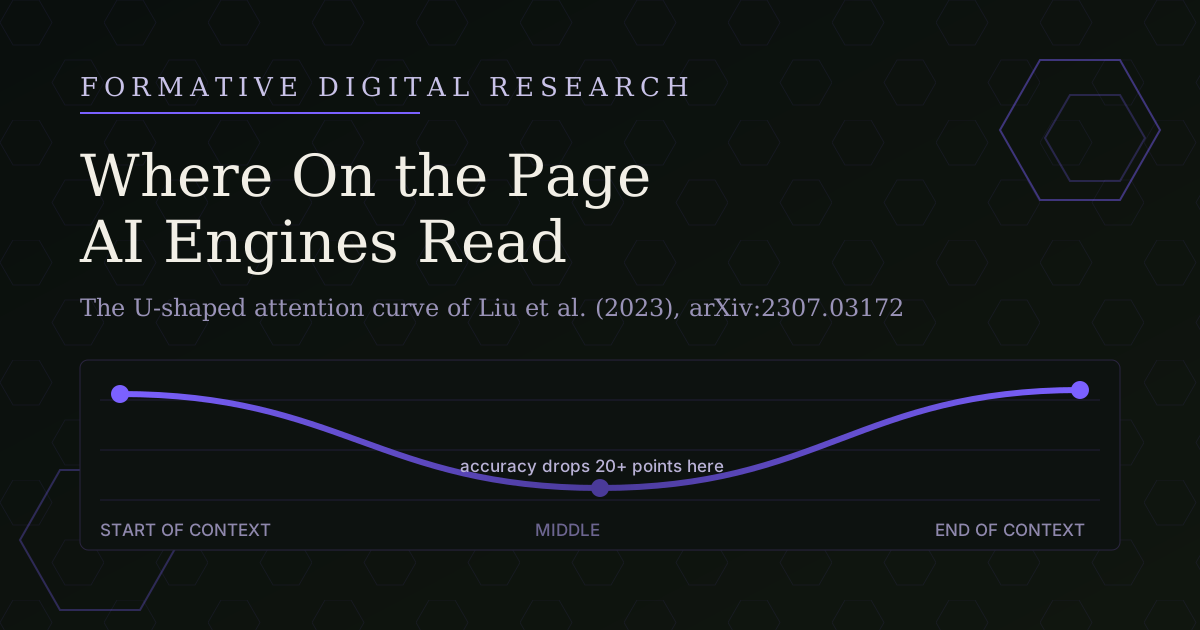
Quick Answer: AI engines use content at the start and end of their retrieved context far better than the middle. Stanford's Lost in the Middle study (Liu et al., 2023) measured accuracy drops of more than 20 points for mid-context information, so pages must state their key answer in the first lines.
Here is a claim that sounds wrong until you see the data: an AI engine that has your page open in front of it, containing the exact answer to the user's question, can perform worse than the same engine with no page at all. Not equally well. Worse. That result sits in Table 1 territory of a 2023 study out of Stanford, Berkeley and Samaya AI, and it is the single most practical finding we know of for anyone deciding where on the page a key claim should live. The study is "Lost in the Middle: How Language Models Use Long Contexts" by Nelson Liu and colleagues (arXiv:2307.03172), and this article walks through what it measured, what it found, and the page-structure decisions that follow directly from the evidence. Where our GEO paper teardown covered which content edits raise answer visibility, this one covers something prior to all of that: whether the machine reading your page absorbs your best material at all.
What the study actually tested
Liu et al. built a controlled version of the situation every retrieved web page finds itself in. They gave language models a question plus a stack of documents, where exactly one document contained the answer and the rest were realistic distractors pulled by a genuine retrieval system. The questions came from NaturalQuestions-Open, a benchmark of 2,655 real historical queries typed into Google, with answers annotated from Wikipedia. Then they did the one thing observational studies cannot do: they moved the answering document around. First position, fifth, tenth, fifteenth, twentieth, holding everything else constant, across stacks of 10, 20 and 30 documents.
The models under test were the recognizable names of that research season: OpenAI's GPT-3.5-Turbo in its 4K and 16K variants, Anthropic's Claude 1.3 in 8K and 100K variants, and two open models, MPT-30B-Instruct and LongChat-13B. The design question was simple. If a model genuinely reads its whole input, moving the relevant document should change nothing. The answer is the same answer; only its position moved.
Position changed a great deal. The authors observed, in their words, that "performance is often highest when relevant information occurs at the very beginning" or end of the input, with a pronounced slump in between. Plot accuracy against document position and you get a U: strong at the first slot, strong again at the last, and a valley across everything in the middle. The paper names the two ends after their counterparts in memory psychology, primacy bias and recency bias, borrowing from the serial-position effect that Ebbinghaus documented in human recall back in 1913. A century-old finding about human memory, reappearing in transformer attention.
The U-shaped curve, in numbers
The magnitude is what makes this operational rather than academic. In the 20-document setting, GPT-3.5-Turbo's accuracy dropped by more than 20 percentage points between its best position and its worst. For a system that scored roughly 75 percent when the answer sat first, the mid-context slump erased a quarter of its correct answers. Nothing about the content changed. The same sentence, carrying the same fact, became dramatically less likely to surface in the model's output because of where it sat in the input.
The below-closed-book result
With the answering document placed mid-context in the 20 and 30-document settings, GPT-3.5-Turbo scored below its own closed-book baseline of 56.1 percent, the score it achieves with no documents at all (Liu et al., 2023, Table 1 and Figure 5). Reading the answer from the middle of a long input was worth less than remembering from training data.
Sit with that for a moment from a publisher's point of view. Your page won the retrieval lottery. It is inside the context window of the engine composing the answer. And if your key claim lands mid-context, the engine may do worse with your page than it would have done ignoring the web entirely. Retrieval got you into the room; position decided whether anyone heard you speak.
The researchers pushed further to check whether this was a reasoning failure or something more basic. They built a synthetic task with no language semantics at all: JSON objects full of random key-value pairs, where the model simply had to return the value for a given key. Pure lookup, no comprehension required. Several models still showed the same U-shaped degradation, with GPT-3.5-Turbo's worst-case accuracy on the hardest setting falling to 45.6 percent on a task that is, mechanically, copy and paste. The middle is not where nuance gets lost. The middle is where retrieval itself gets unreliable.
Why bigger context windows did not fix it
The obvious objection in 2023 was that context windows were about to get huge, so the problem would age out. The study tested that directly and the result deserves more attention than it gets. When the same input fit inside both a standard model and its extended-context sibling, their accuracy curves were nearly superimposed. GPT-3.5-Turbo at 16K tokens tracked the 4K version. Claude 1.3 at 100K tokens tracked the 8K version. Extending how much a model can accept did nothing, in this data, to change how unevenly it uses what it accepted.
The authors also checked whether instruction tuning caused the bias, by comparing MPT-30B against its instruction-tuned variant. Both showed the U. Follow-up experiments on Llama 2 found the curve emerging with scale: the 7B model leaned only toward recent tokens, while 13B and 70B models developed the full U shape. The pattern appears to be a deep property of how large transformer models allocate attention over long inputs, not a quirk of one training recipe. Later model generations have narrowed the valley, and needle-in-a-haystack scores now look strong in vendor benchmarks, but position-sensitivity on realistic multi-document tasks has remained a live research topic through 2025 and 2026. Betting your visibility on the assumption that the machines will eventually read everything equally is a bet with no payout date.
What this means once your page gets retrieved
Now connect the lab to the live web. Google AI Overviews, ChatGPT Search, Perplexity and Gemini all run some version of the same pipeline: retrieve a set of sources for the query, pack them into a context window, generate an answer with citations. That is precisely the multi-document setup Liu et al. tested. Your page never arrives alone. It arrives as one document among several, occupying a position in someone else's context window that you do not control, alongside chunks of your competitors.
Two positional games are being played at once, and you only get to play one of them. The first is where your document sits in the retrieved stack, which the engine's ranking decides. The second is where your key claims sit inside your own document, which you decide completely. Retrieval pipelines rarely pass whole pages to the model; they chunk them, embed the chunks, and pass the chunks that score best against the query. A page whose central claim is buried in paragraph fourteen, halfway down a 2,500-word essay, produces middle chunks where the claim is diluted across scene-setting prose. A page that states its claim in the opening block produces a first chunk that is dense, self-contained and quotable.
There is also a relevant finding in the study about how many retrieved documents actually help. When the researchers ran a realistic retriever over Wikipedia, reader accuracy flattened long before retrieval quality did: going from 20 retrieved documents to 50 improved answers by roughly 1.5 percent for GPT-3.5-Turbo. Engines learned this economics early, which is why most cite a handful of sources rather than dozens. The competition is not to be somewhere in a long list. It is to be one of a few documents, with your substance positioned where the model demonstrably reads.
Matt Griffin, Formative Digital: "When we started testing our own clients' pages against AI engines, the pattern that kept repeating was that the pages getting quoted were not the deepest ones, they were the ones that said the important thing early. I have watched an engine cite a competitor's thinner page over a client's genuinely better one because the client's key stat was sitting under 800 words of warm-up. The machine never dug that far. We restructured, same facts, answer moved to the top, and the citations followed. Position was the whole difference."
The ski ramp: field data agrees with the lab
Controlled experiments earn trust when independent field measurements point the same direction, and here they do. A study by growth strategist Kevin Indig, reported by Search Engine Land in February 2026, analyzing 18,012 verified ChatGPT citations against the source documents, found that 44.2 percent of citations came from the first third of the cited page, with citation likelihood falling steeply after that point. Indig, whose research we drew on in our AI Overviews optimization guide, describes the resulting shape as a ski ramp: a cliff after the early portion of the document, then a long shallow tail. A lab curve from 2023 and a citation-log curve from 2026, drawn from entirely different methods, both slope away from the middle of the document.
Our own measurements rhyme with this. In the testing behind our AI citation accuracy study, we found engines not only favour early-positioned content but sometimes misattribute or garble claims pulled from deep inside long pages, which is the qualitative face of the same quantitative slump. An engine straining to use mid-context material does not always fail cleanly. Sometimes it half-reads, and a half-read claim quoted with your name on it is arguably worse than being skipped.
The playbook, part one: the answer goes first
Everything above converges on one structural rule, and it is the reason every article Formative Digital publishes opens with a quick-answer block. The pattern is not a house style preference. It exists because of this mechanism. The first 50 to 60 words of the page state the complete answer to the query, in self-contained sentences, with the single most important fact bolded. When a retrieval pipeline chunks that page, the opening chunk carries the entire claim with no dependence on anything below it. When a model reads the page in a stack of retrieved documents, the claim sits in the position the U-curve favours most.
This maps to Vector 4 in our methodology, Embed: writing the answer the engines extract, rather than the essay the engines skim. The discipline is harder than it sounds, because good writers are trained to build toward conclusions. For AI-readable pages, the build-up is inverted. Conclusion first, evidence after, the way a well-run engineering postmortem leads with the finding. Notice what this article itself did: the below-closed-book result, our strongest single fact, appeared in the first paragraph, not saved for a reveal.
The playbook, part two: every section is a small page
The subtler application is treating each H2 section as a miniature of the whole page, because chunking does not respect your narrative arc. A chunk boundary can fall anywhere, and heading-aware pipelines often split precisely at H2s. Each section therefore gets its own primacy position, and it should be spent the same way the page's was.
Structuring one section for extraction
- First sentence answers the heading: if the H2 asks a question, sentence one resolves it before any context arrives.
- Middle carries dense, anchored evidence: named sources, dated figures, short paragraphs. The valley of the curve is survivable when every sentence is load-bearing.
- Last sentence restates the takeaway: the section's end is a recency position. Close on the claim, not on a transition.
- Each block stands alone: a reader, or a model, dropped into the section with no memory of the rest of the page should still extract the point.
Ending sections with restatement feels redundant to the person who wrote the section. It is not redundant to a model whose attention peaks exactly there. The end of a section is the second-best real estate that section owns, and most writers spend it on connective tissue like "with that in mind, let's turn to..." which no engine will ever quote. State the conclusion again, in different words, and let the recency position work for you.
The playbook, part three: FAQs are edge positions by construction
A well-built FAQ section is a row of tiny documents, each with its own beginning and end and nothing in between to get lost in. Question as heading, complete two-to-four sentence answer immediately below, every answer self-contained. This is why FAQ blocks keep showing up in citation studies as disproportionately extracted: structurally, they are all primacy and recency with the middle removed. The FAQPage schema on this page mirrors its visible questions word for word, which gives engines a machine-readable copy of the same edge-positioned answers. The same logic favours summary boxes, definition callouts and tables, any element that compresses a claim into a bounded block a chunker cannot smear.
What does not survive this mechanism is the pyramid-style essay that saves its synthesis for the final third and its best evidence for the long middle. Those pages read beautifully to a patient human. To a position-biased model reading them inside a stack of competitors, the strongest material occupies the weakest seats.
What this evidence does not say
Three honest limits, because the study is strong enough that it does not need inflating. First, Liu et al. tested 2023-era models; current engines run on newer architectures whose positional behaviour has measurably improved, even if the bias has not vanished from the follow-up literature. Treat the U-curve as a persistent tendency, not a fixed law of nature. Second, the experiments measured question answering over retrieved stacks, not web citation directly; the field data from citation logs is what bridges that gap, and correlation in field data is looser than causation in a lab. Third, position is one lever among several. A front-loaded page with weak sourcing, thin evidence and no entity clarity will still lose to a well-sourced competitor. Structure decides whether your substance gets read; it does not substitute for having substance. Results from restructuring vary by industry, by competition and by how badly buried the answers were to begin with.
Where to start on your own site
The audit sequence we run, and the one you can run yourself this afternoon, is short. Take your five most important pages. For each, find the single claim you most need AI engines to repeat, then measure how many words a reader passes before reaching it. In our client audits the typical distance runs 400 to 900 words, which places the claim squarely in the valley of the curve on almost any chunking scheme. Move it into the opening block, give each major section a first-sentence answer, and close key sections by restating their point. This restructuring workstream is one of the standing components of our content engine service, but the core move requires no agency at all. It requires deciding that the top of the page belongs to the reader's answer, not to your introduction.
Get your free AI visibility audit
We will check where your key claims actually sit on your most important pages, test what ChatGPT, Perplexity, Gemini and Google AI Overviews currently extract from them, and show you which answers are buried mid-page. No charge, no obligation, a reply within one business day.
Read the primary source
The paper is fourteen pages, free on arXiv, and written with unusual clarity for the genre. It was later published in the Transactions of the Association for Computational Linguistics, which means it cleared full peer review, not just a preprint server. If a consultant tells you page position does not matter for AI visibility, or tells you it is the only thing that matters, either way the study is the fastest reality check available. If you want to talk through how the finding applies to your specific pages, our contact page is the direct route, and the research hub holds the rest of our paper teardowns.
Frequently Asked Questions
Does content position on the page really change whether AI engines cite it?
The controlled evidence says yes. Liu et al. (2023) measured accuracy drops of more than 20 percentage points when the passage containing the answer moved from the edges of a model's input to the middle. Field data points the same way: a February 2026 study by Kevin Indig, reported by Search Engine Land, of 18,012 verified ChatGPT citations found 44.2 percent came from the first third of the cited document. Position is not the only factor, but it is a measured one.
What does Lost in the Middle actually mean?
It is the title of a 2023 Stanford-led study (Liu et al., arXiv:2307.03172) showing that language models use information at the beginning and end of their input context far more reliably than information in the middle. Plotted against position, accuracy forms a U-shaped curve. The name has since become shorthand for the whole phenomenon of mid-context information being under-used by AI systems.
Where should the main answer sit on a page built for AI search?
In the first visible block after the H1, stated in complete, self-contained sentences. Every Formative Digital article opens with a 50-word quick-answer block for exactly this reason: when a retrieval pipeline chunks the page, the opening chunk carries the full claim. Each H2 section should then repeat the pattern in miniature, answering its own heading in the first sentence.
Do larger context windows fix the lost-in-the-middle problem?
Not in the study's data. Liu et al. compared standard models against their extended-context versions, including GPT-3.5-Turbo at 4K versus 16K tokens and Claude 1.3 at 8K versus 100K tokens, and found their accuracy curves nearly identical whenever the input fit both windows. A bigger window lets a model accept more text; it does not make the model treat every position in that text equally.
Does this positional effect matter for short pages too?
Less for the page itself, more for the context it lands in. A 600-word page may be short, but the AI engine reads it alongside four to ten other retrieved sources, so the combined input is long and your page can still sit in the neglected middle of it. Clear front-loaded answers help the model extract your claim regardless of where the retriever placed you, which is why structure matters even on brief pages.
Sources
- Liu, N. F., Lin, K., Hewitt, J., Paranjape, A., Bevilacqua, M., Petroni, F., & Liang, P. (2023). Lost in the Middle: How Language Models Use Long Contexts. Transactions of the Association for Computational Linguistics, 12. arXiv:2307.03172 (v3, 20 November 2023). All experimental figures in this article (the U-shaped curve, closed-book baselines, key-value retrieval results, extended-context comparisons) are drawn from this paper. Link
- Aggarwal, P., Murahari, V., Rajpurohit, T., Kalyan, A., Narasimhan, K., & Deshpande, A. (2024). GEO: Generative Engine Optimization. KDD '24, Barcelona. arXiv:2311.09735. Source for the content-edit visibility findings referenced alongside this study. Link
- Search Engine Land. (2026, February 18). 44% of ChatGPT citations come from the first third of content: Study. Coverage of Kevin Indig's analysis of 18,012 verified ChatGPT citations. Link
- Forrester, D. (2026, February 15). Why AI Misreads the Middle of Your Best Pages. Duane Forrester Decodes. Practitioner analysis of positional bias and context compression in AI retrieval pipelines. Link
- Google Search Central. (2026). AI features and your website. Google's official documentation on how AI Overviews and AI Mode surface web content. Link