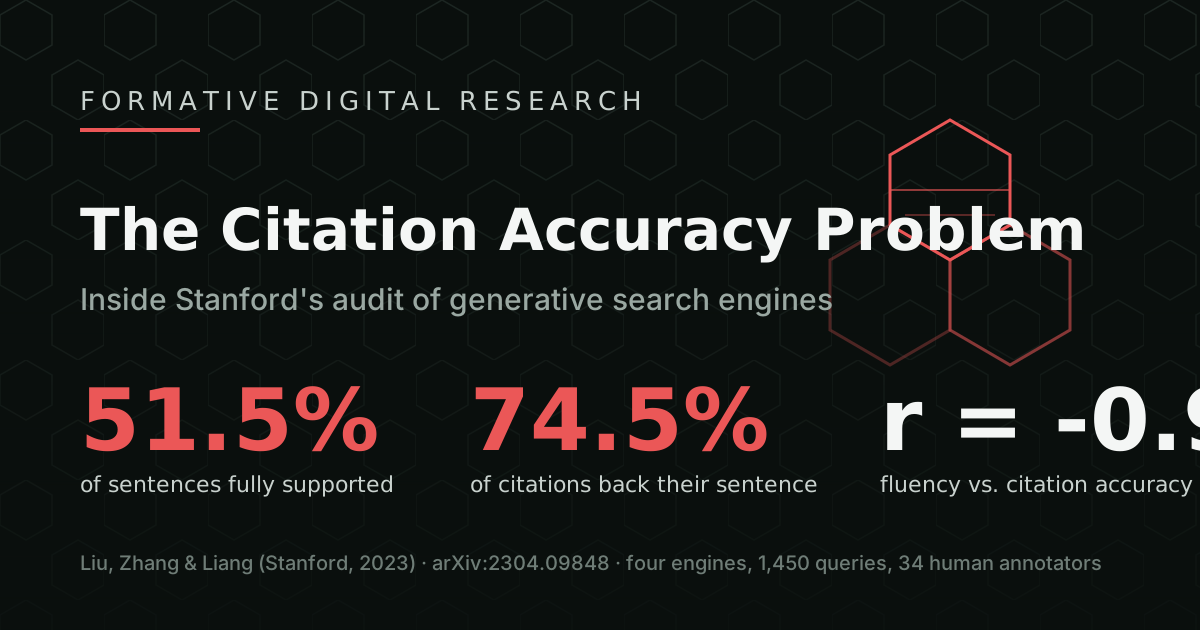
Quick Answer: Stanford's verifiability audit of four generative search engines found only 51.5 percent of generated sentences were fully supported by their citations, and just 74.5 percent of citations backed their sentence (Liu et al., 2023). Fluency correlated inversely with accuracy: the answers that read best cited worst. Businesses respond with extractable statements, consistent entity data and per-engine monitoring.
Here is the finding that should reorder how you think about AI search: the better an AI answer reads, the worse its citations tend to be. Not sometimes. In the only large human audit of commercial generative search engines, the correlation between how helpful an answer seemed and how accurately it cited its sources was negative at r = -0.96, about as close to a perfect inverse relationship as field data ever gets. The polish is not evidence of care. Measured across four engines and 1,450 real queries, the polish predicted the opposite.
That audit is Evaluating Verifiability in Generative Search Engines by Nelson Liu, Tianyi Zhang and Percy Liang of Stanford (arXiv:2304.09848). It is the paper that put hard numbers on a question every business owner should be asking: when an AI engine answers a customer's question and attaches little bracketed citations, do those citations actually say what the answer claims? The short version of the data: about half the time, no. This article works through what the team measured, how far apart the four engines landed, why the fluent-but-wrong pattern is structural, and what a business can do about a failure mode it does not control.
What the Stanford team actually did
The study was a human audit, not a benchmark run by machines. The researchers collected responses from four commercial generative search engines, Bing Chat, NeevaAI, perplexity.ai and YouChat, scraped between late February and late March 2023. Each system answered 1,450 queries drawn from twelve distributions: historical Google queries from the NaturalQuestions dataset, live questions pulled from Reddit's Explain Like I'm Five community the moment they were posted, how-to keyword queries derived from WikiHow, generated debate questions, and open-ended essay questions from the All Souls College entrance exam at Oxford. The spread was deliberate. Some queries have a clean extractive answer sitting on a webpage somewhere; some have no single source that answers them at all.
Thirty-four trained annotators then judged every response on four dimensions: fluency, perceived utility, citation recall and citation precision. The judging framework for support was Rashkin et al.'s "attributable to identified sources" standard: a sentence counts as supported only if a generic reader, shown the cited pages, would agree the pages say it. Agreement between annotators was high, above 82 percent pairwise on a triple-annotated sample, so the numbers below are not one rater's opinion. ChatGPT and Bard were excluded for a simple reason: in March 2023 neither attached in-line citations at all, so there was nothing to verify.
Citation recall and precision, translated out of the jargon
The two metrics carry the whole study, and both translate cleanly into questions a business owner already cares about. Citation recall asks: of everything the engine asserted, how much is actually backed by a source it showed you? A sentence with no citation, or with citations that do not cover what it says, fails recall. Citation precision asks the mirror question: of the citations the engine attached, how many genuinely support the sentence they sit beside? A real link pointing at a page that says something different fails precision.
The distinction matters because the failure modes feel different on the receiving end. Low recall means the engine is asserting things nobody vouched for; the unsupported sentence sits between two cited ones and borrows their credibility. Low precision means the engine is vouching wrongly; the reader who clicks through finds a page that does not say what the answer claimed. An engine could game recall by citing everything for everything, which is why the pair travels together. The Stanford team also reports a combined citation F1, the harmonic mean of the two, for readers who want one number per engine.
The headline averages: 51.5 percent recall, 74.5 percent precision. In practice that means roughly one generated sentence in two lacked full support from its citations, and roughly one citation in four did not support its sentence. The authors called the results, in their words, "concerningly low for systems that may serve as a primary tool" for people seeking information. Meanwhile the same responses averaged 4.48 out of 5 for fluency and 4.50 for perceived utility. Readers loved the answers. The sourcing underneath was coin-flip territory.
Four engines, four very different failure profiles
The averages hide dramatic spread, and the spread is the practitioner lesson. Recall and precision per engine, as measured:
| Engine | Citation recall | Citation precision | Fluency / utility |
|---|---|---|---|
| perplexity.ai | 68.7 | 72.7 | 4.51 / 4.56 |
| NeevaAI | 67.6 | 72.0 | 4.43 / 4.48 |
| Bing Chat | 58.7 | 89.5 | 4.40 / 4.34 |
| YouChat | 11.1 | 63.6 | 4.59 / 4.62 |
Read the corners of that table. Bing Chat cited most accurately by a wide margin, 89.5 percent precision, and scored lowest on how helpful people found it. YouChat scored highest on fluency and helpfulness while backing 11.1 percent of its sentences with citations, a 58-point recall gap against perplexity.ai at the top. The engine users enjoyed most was the one whose claims were least verifiable. One further wrinkle: NeevaAI declined to answer 22.7 percent of queries because its response format lived inside a conventional results page, while the other three answered nearly everything, so head-to-head comparison needs that caveat attached.
Query type moved the numbers too. When a question had a clean extractive answer somewhere on the web, recall rose; on the open-ended All Souls essay questions, where no page directly answers the query, average recall fell to 44.3 and precision to 67.8. Engines do not gracefully say "no source covers this." They keep writing, and the citations stop keeping up.
The inverse correlation: why the best-sounding answer cites worst
The r = -0.96 relationship between precision and perceived utility is the study's most quotable result, and the authors offer a mechanism rather than leaving it as a curiosity. Engines that copy or closely paraphrase from their retrieved pages almost automatically earn accurate citations, because copied text is supported by the page it came from. But copied text answers the retrieved page's question, not necessarily the user's. The paper's worked example is an essay question about whether cooperation or competition drives the evolution of society; Bing Chat retrieved pages about biological evolution, quoted them faithfully, cited them precisely, and produced an answer that largely missed the question. High precision, low usefulness.
Engines that write more freely invert the trade. They produce responses tuned to the question as asked, which readers rate as helpful, while the generated sentences drift away from anything the cited pages actually state. The team backed this with similarity analysis: engines whose sentences scored higher BLEU and BERTScore overlap against their cited evidence also had higher citation precision, with a correlation of 0.80. The authors describe the overall effect as a "facade of trustworthiness", and that phrase is the business takeaway in miniature. The signals a human uses to decide whether to trust an answer, confidence, coherence, relevance, are exactly the signals that carried no information about whether the sourcing was sound.
What a failed citation looks like when it is your business
Abstract percentages become concrete the first time an engine gets your business wrong. Map the two failure types onto a commercial query and the stakes are obvious. A recall failure means the engine asserts something about your category with no source at all behind it: a made-up service area, an invented product claim, a price that belongs to nobody. A precision failure is often worse, because it comes with a receipt: the engine states a claim about you and cites a page about someone else, or cites your page for a sentence your page never contains. Your competitor's return policy, attributed to you, with your URL in brackets. The study's opening example is exactly this shape: a statement about the James Webb Space Telescope backed by a NASA citation that discusses a different accomplishment entirely.
"The one that sticks with me from client audits is a service business where the engine quoted a guarantee, word for word, that came from a competitor two towns over, and presented it as the client's. The citation pointed at the competitor's page. The customer reading that answer has no reason to click through and check. If the client had not been running the queries themselves, nobody would ever have known the promise was being made on their behalf."
Matt Griffin, Founder, Formative DigitalTwo structural details from the paper make this failure hard to catch. First, the study found unsupported statements sitting inside otherwise well-cited paragraphs, which means spot-checking one citation tells you nothing about its neighbours. Second, the authors are careful to note that verifiability is not factuality: a supported sentence can still be false if the source is wrong, and an unsupported sentence can happen to be true. The audit measured whether readers could check claims, and found that half the time they could not, in systems whose entire interface implies they can.
A 2023 baseline, not a 2026 verdict
Honesty about the snapshot date is owed here, because this is a study people quote carelessly. The responses were captured in February and March 2023. Neeva shut down months later. Bing Chat became Copilot. Perplexity has rebuilt its retrieval and citation stack repeatedly. ChatGPT, absent from the study entirely, now runs its own search product with in-line citations. Anyone telling you "AI search is 51.5 percent accurate" in the present tense is misusing the paper, and an agency whose pitch depends on you not checking that date is demonstrating the exact behaviour the study warns about.
What the paper still gives you, three years on, is two durable assets. The first is the measurement framework: recall and precision, judged against the AIS standard, remain the right instrument for auditing any engine that attaches citations, which is why follow-up research keeps using them. The second is the structural insight: the fluency-accuracy trade-off is not a bug in one 2023 product. It falls out of how retrieval-augmented generation works, faithfulness to sources pulling against relevance to the question, and every engine since has had to pick its point on that curve. Independent expert evaluation from the same year, Peskoff and Stewart's assessment of ChatGPT and YouChat responses, reached a matching conclusion from a different angle: coherent, concise, frequently undersourced. The baseline is dated. The mechanism is not.
The three levers a business actually controls
You cannot patch an engine. You can shrink the surface area on which it fails about you, and the study's mechanics point at exactly where. Engines err most when sources are ambiguous, when claims and entities are loosely attached, and when no page states the fact cleanly enough to lift. Each of those is a property of your content, not theirs.
Citation-proofing your key pages
- Write statements that survive extraction. One verifiable fact per sentence, with the business named in the sentence rather than implied by context. "Formative Digital is based in Brantford, Ontario" survives being lifted alone; "We are based here" does not. The Stanford data shows engines segment responses at the sentence level, so the sentence is the unit that travels.
- Remove ambiguity an engine could inherit. The paper notes that a single citation's scope is often unclear even to human annotators when sentences pack multiple claims. Pages that bundle three claims into one sentence invite an engine to cite you for the two you did not make.
- Date and quantify. A claim with a number and a date is checkable, and checkable claims give precision-oriented engines something safe to attach your URL to.
- Keep entity data identical everywhere. Misattribution thrives where two businesses look interchangeable to a retrieval step. Consistent name, address, phone and service descriptions across your site, profiles and directories give the engine fewer ways to swap you with a competitor.
The deeper pattern in the Princeton GEO research points the same direction: Aggarwal et al. (2023) found that adding citations, quotations and statistics to source content measurably raised its visibility in generative answers. Content built to be verified is content engines can afford to cite. The two research threads meet at the same instruction: make the true version of your facts the easiest version to attach a citation to.
Find out what the engines are claiming about you
We will run your business through ChatGPT, Perplexity, Gemini and Google AI Overviews, log every claim and every citation, and flag the ones that are wrong or misattributed. No charge, and a reply within one business day.
Monitoring per engine: Vector 11 applied to citation errors
The strongest argument for monitoring hides in the study's engine table: the four systems did not fail the same way. One cited accurately and answered poorly; one answered beautifully and barely cited; two sat in between with different retrieval habits. Our own cross-engine work found the same fragmentation from the citation side, with most cited domains unique to a single engine; the numbers are in our engine consensus gap study. A monthly check of one engine tells you almost nothing about the other three, and an error can live in exactly one of them for a year.
The working routine is Vector 11, Measure, pointed at claims instead of rankings. Run your real customer questions through each major engine on a schedule. Log three things per engine: whether you are named, what is claimed about you, and which sources each claim cites. The third column is where precision failures surface, because a claim about you citing someone else's page is visible the moment you look for it. The method and tooling are documented in our guides to tracking AI citations and measuring AI visibility, and our AI citation monitoring service runs the same loop continuously for businesses that would rather not staff it. However it gets done, somebody should be reading what the machines say about you, because the study's whole point is that your customers will not click through to check.
Why the pattern outlives the products
Every engine in the Stanford audit has been retired, renamed or rebuilt, and the finding still matters, because the trade-off it measured is baked into the architecture every successor inherited. A generative engine must retrieve pages, then write. Stay close to the retrieved text and the citations hold but the answer serves the source's framing. Write toward the user's question and the answer improves while its tether to the sources stretches. Liu, Zhang and Liang caught four different products at four different points on that curve, and the curve itself is the durable object. Newer engines with better retrieval move along it; nothing published since shows one escaping it.
For the businesses being cited, that permanence is oddly clarifying. It means the work is not chasing whichever engine currently scores best; it is making your facts cheap to verify, so that wherever an engine sits on the faithfulness curve, the accurate claim about you is the low-effort claim. How engines choose which sources to cite in the first place is its own research question, covered in our study of LLM citation behaviour, and the rest of our measurement work lives in the research hub. This is Engineering Principles applied to a messy surface: you do not get to control the machine, so you control the inputs it reads and you verify the outputs it makes. If you want a second set of eyes on either half, talk to us.
Frequently Asked Questions
How accurate are AI search engine citations?
The measured baseline comes from Stanford's 2023 verifiability audit (Liu, Zhang and Liang, arXiv:2304.09848). Across Bing Chat, NeevaAI, perplexity.ai and YouChat, human annotators found that on average only 51.5 percent of generated sentences were fully supported by their citations, and only 74.5 percent of citations actually supported the sentence they were attached to. Engines have iterated since that snapshot, so current systems may score differently, but no comparable audit has shown the problem to be solved.
What is the difference between citation recall and citation precision?
Citation recall asks: of everything the engine said, how much is actually backed by a cited source? Citation precision asks: of the citations the engine attached, how many genuinely support the sentence they sit beside? An answer can score high on one and low on the other. A response that cites a source for every sentence but picks the wrong sources has high recall and low precision; a response that cites accurately but leaves half its claims unsourced has the reverse problem.
Why do fluent AI answers tend to have worse citations?
The Stanford team found citation precision inversely correlated with perceived utility at r = -0.96 across the four engines they audited. Their analysis points to a trade-off: engines that copy or closely paraphrase from cited pages earn accurate citations but produce stilted, less relevant answers, while engines that write freely produce answers people rate as helpful but drift away from what their sources actually say. Polish and verifiability pulled in opposite directions in every system measured.
Can an AI engine attribute a claim about my business to the wrong source?
Yes, and the Stanford audit documents the mechanism. When roughly one citation in four fails to support its sentence, the failure often lands as misattribution: a statement about one entity backed by a page about another, or a real page cited for a claim it never makes. For a business this means an engine can describe you using a competitor's pricing, hours or warranty terms, or cite your site as the source for something you never published. Unambiguous, extractable statements on your own pages reduce the room for this error.
Is the 51.5 percent figure still true for ChatGPT and Perplexity today?
Treat it as a measured baseline, not a current scorecard. The Stanford responses were scraped in February and March 2023, ChatGPT and Bard were excluded because they did not yet provide in-line citations, and every engine in the study has been rebuilt or retired since. What has held up is the framework: recall and precision remain the correct way to ask whether an AI answer about your business is trustworthy, and the fluency-versus-accuracy trade-off is structural, not a bug one patch removed.
What can a business do about AI citation errors?
Three things are in your control. First, publish statements engines can lift whole: one fact per sentence, entity named, number and date included, no pronoun chains. Second, keep your entity data identical everywhere, because corroboration is what lets a retrieval step match a claim to the right business. Third, monitor each engine separately by running your real customer questions on a schedule and logging whether you are named, what is claimed and which sources are cited. You cannot stop an engine from erring, but you can shrink the target and catch the errors early.
Sources
- Liu, N. F., Zhang, T., & Liang, P. (2023). Evaluating Verifiability in Generative Search Engines. Stanford University, arXiv:2304.09848. Human evaluation of Bing Chat, NeevaAI, perplexity.ai and YouChat across 1,450 queries: average citation recall 51.5%, citation precision 74.5%, precision inversely correlated with perceived utility (r = -0.96). Link
- Rashkin, H., Nikolaev, V., Lamm, M., et al. (2022). Measuring Attribution in Natural Language Generation Models. arXiv:2112.12870. The AIS (attributable to identified sources) framework used as the support standard in the Stanford audit. Link
- Peskoff, D., & Stewart, B. (2023). Credible without Credit: Domain Experts Assess Generative Language Models. Proceedings of ACL 2023. Expert evaluation finding ChatGPT and YouChat responses coherent and concise but frequently undersourced and inaccurate. Link
- Aggarwal, P., Murahari, V., Rajpurohit, T., Kalyan, A., Narasimhan, K., & Deshpande, A. (2023). GEO: Generative Engine Optimization. arXiv:2311.09735, Princeton University. Adding citations, quotations and statistics measurably raised source visibility in generative answers. Link