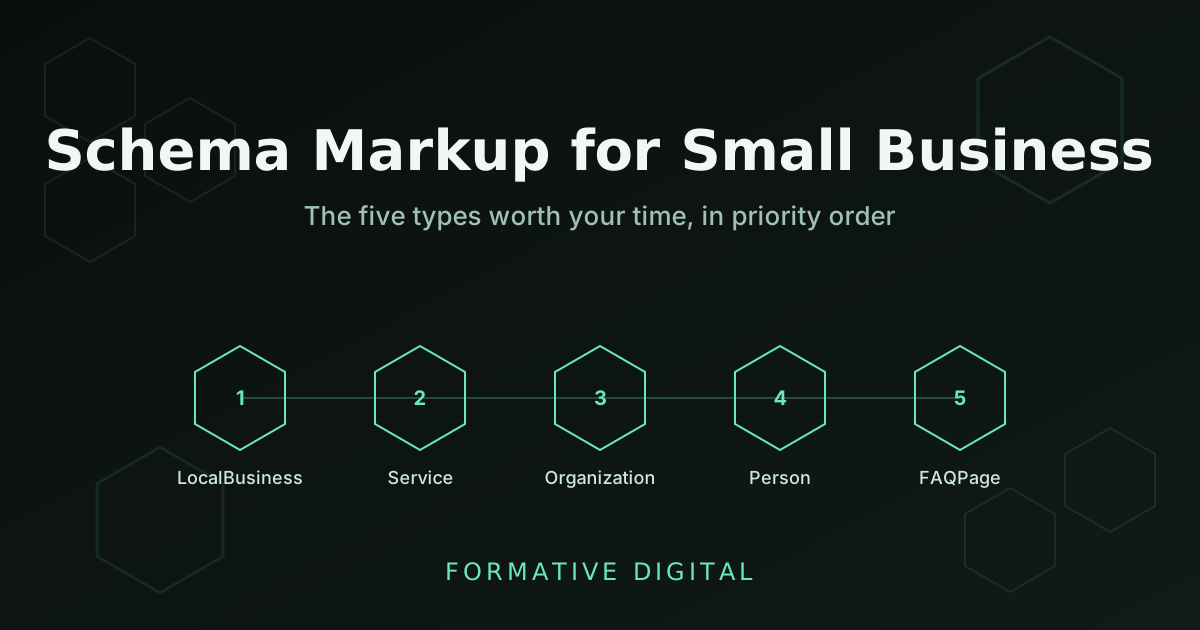
Quick Answer: Most small businesses need five schema types: LocalBusiness, Service, Organization, Person, and FAQPage, in that order. Start with LocalBusiness because it corroborates your Google Business Profile, keep every field identical to your live listing, then validate with Google's Rich Results Test. Skip Review, Product, and VideoObject until the basics hold.
Here is the claim that surprises most owners we talk to: the biggest schema problem on small-business websites is not missing schema. It is wrong schema. Plugin-generated blocks that repeat the same Organization object on every page, an address in the code that disagrees with the Google Business Profile, FAQ markup wrapped around questions that appear nowhere on the visible page. A machine reading that site does not see a business trying its best. It sees a business contradicting itself, and contradiction is the one thing an AI answer engine will not reward. This guide covers what a typical local business should actually implement, in what order, what to leave alone, and what each route honestly costs. It is written by Matt Griffin, founder of Formative Digital in Brantford, Ontario, whose day job includes reading other people's structured data so you do not have to.
What schema markup does for a small business
Schema markup is a block of JSON-LD code, using the vocabulary published at Schema.org, that states the facts of your business in a form machines can parse without guessing: who you are, where you are, what you sell, when you are open. Your customers never see it. Google, Bing, ChatGPT, Perplexity and Gemini do, and they use it two ways. First, valid markup makes pages eligible for rich results, the enhanced listings with FAQ dropdowns, breadcrumbs and business details that occupy more of the results page. Second, and increasingly more important, structured data acts as entity verification: it lets a retrieval system confirm that the plumber on this website, the plumber in this Google Business Profile, and the plumber in this directory listing are the same real company.
Two honest qualifiers before the sales pitch writes itself. Google has stated for years that structured data is not a direct ranking factor, and a 2026 Ahrefs study found no automatic AI-citation lift from simply adding markup. Schema does not push you up a list. What it does is remove ambiguity, and ambiguity is what keeps cautious systems from naming you. Google also tightened rich-result eligibility in its March 2026 core update, which cut FAQ rich-result impressions sharply across tracked sites and raised the penalty for markup that does not match visible content. The direction of travel is clear: sloppy schema is worth less than none, and accurate schema is table stakes for being machine-readable at all. In our 12 Vectors methodology this whole page sits inside Vector 6, Structure.
The five types, in priority order
The Schema.org vocabulary defines over 800 types. A typical local business needs five. The order below is deliberate: each type builds on the one before it, and the early ones do most of the work.
| Priority | Schema type | Where it goes | What it proves |
|---|---|---|---|
| 1 | LocalBusiness (or subtype) | Homepage, contact page | You exist, here, with these hours and this phone number |
| 2 | Service | Each service page | You perform this specific work in this area |
| 3 | Organization | Site-wide, one canonical block | The brand entity behind the location |
| 4 | Person | About page, bylines | A named human with credentials stands behind the work |
| 5 | FAQPage | Pages with visible Q&A | Your answers to the questions people actually ask |
Everything else, Review, AggregateRating, Product, VideoObject, HowTo, Event, can wait, and for many businesses can wait forever. More on that below.
Type one: LocalBusiness, the anchor
LocalBusiness schema is the machine-readable version of your storefront sign, and it goes in first because every other type on your site hangs off it. The critical decision is specificity: Schema.org publishes dozens of subtypes, and Google's guidance is to use the most specific one that fits. A dental office marks up as Dentist, not LocalBusiness. A repair garage is AutoRepair. A salon is HairSalon. The subtype tells the machine your category without a single keyword being written.
The critical discipline is agreement. The name, address and phone number inside the code must match your Google Business Profile character for character, and match the visible footer of your site, and match your directory listings. This is not perfectionism for its own sake. Entity confirmation works by cross-referencing sources; every mismatch is a vote against you being the business the machine thinks it found. Include the fields that answer real customer questions: opening hours, geo coordinates, price range, the URL, and areaServed if you travel to customers. Our full walkthrough of every property, subtype selection and the aggregate-rating question lives in the LocalBusiness schema guide.
Type two: Service, one per service page
Service schema describes a specific thing you do, and it belongs on the page that sells that thing. A furnace-repair page carries a Service object whose provider property points at your LocalBusiness block, whose serviceType names the work, and whose areaServed lists the communities you cover. This is the type most small businesses skip, and skipping it is expensive, because service-level queries are where buying intent lives. Nobody hires "a company"; they hire duct cleaning in their town, and the page that states that pairing in structured form is easier for both a search engine and an answer engine to match to the query.
One rule keeps Service schema out of trouble: one page, one service, one object. Do not stack twelve Service objects on the homepage and call the job done; the machine has no page-level evidence to attach them to. If you sell twelve services, that is twelve pages, each with its own object. The property-by-property breakdown, including hasOfferCatalog for multi-service firms, is in our Service schema markup guide.
Type three: Organization, the brand entity
Organization schema answers a different question than LocalBusiness: not "where is the shop" but "what is the company." It carries your logo, your founding details, your legal name, and, most usefully, the sameAs array, a list of URLs that point to your profiles elsewhere: LinkedIn, Facebook, industry directories, your Google Business Profile. Think of sameAs as sworn testimony that all of those pages describe one entity. For a single-location business, Organization and LocalBusiness overlap heavily, and the clean pattern is a single Organization block referenced by @id from every page, with the LocalBusiness block extending it on the homepage. What kills trust is the opposite pattern we find constantly in audits: a plugin stamping a slightly different Organization object onto every page of the site, so the machine meets forty near-identical twins instead of one company.
Type four: Person, the human behind the business
Person schema names the owner or practitioner and connects them to the business through the worksFor property. For a small business this is quietly powerful, because expertise assessments increasingly track named people, not just brands. A Person object with jobTitle and a knowsAbout array listing the practitioner's real areas of competence gives assessors a human entity to attach experience signals to. It matters most in fields where the person is the product: trades with licensed operators, clinics, law offices, consultancies. It costs ten minutes, it is entirely factual, and it is one of the few schema moves your competitors almost certainly have not made. Keep it honest: real name, real title, real competencies. Machines cross-check people now too.
Type five: FAQPage, with one hard rule
FAQPage schema wraps the questions and answers on your page so they can be extracted whole. It earned a spot in the five because question-shaped content is exactly what conversational engines retrieve, and a marked-up answer is a pre-packaged citation. But this is the type Google cracked down on hardest in the March 2026 update, so the rule is absolute: the questions and answers in the code must appear on the visible page, word for word. Marking up FAQs the visitor cannot see, or code answers that abbreviate the visible ones, now costs you the rich result and degrades page trust. Write five to seven questions customers genuinely ask, answer them plainly on the page, mirror them exactly in the markup, and stop there. Our note on FAQ schema for AI search covers how answer engines lift these blocks.
What to skip, and why restraint wins
The types below look tempting and mostly are not, for a typical service business:
Leave these until the five are solid
- Review and AggregateRating: Google no longer displays self-serving review stars, meaning ratings a business marks up about itself. Your reviews live on Google and third-party platforms; marking them up on your own site rarely earns anything and often triggers warnings.
- Product: built for e-commerce catalogues with prices and stock levels. A service business forcing its offerings into Product objects is miscategorizing itself.
- VideoObject and Event: only worth it if video or events are genuinely part of how you win customers, and only with real dates and real files behind them.
- HowTo: Google removed HowTo rich results for most devices back in 2023. Add it only where a page truly is a step-by-step procedure and you want the semantic clarity, not the stars.
The pattern worth naming: schema fails through ambition more often than through absence. Five accurate types beat fifteen approximate ones, because every object you publish is a claim the machine can test, and failed claims are remembered site-wide.
Get your free AI visibility audit
We will read your site's structured data the way the machines do, show you what validates, what contradicts your Google Business Profile, and what ChatGPT, Perplexity and Google AI Overviews currently believe about your business. No charge, reply within one business day.
A minimal worked example you can copy
Below is a minimum-viable LocalBusiness block for a fictional Brantford bakery. Swap in your real details, choose your correct subtype, and it is deployable today. This is deliberately small: every property here answers a question a customer or an engine actually asks.
<script type="application/ld+json">
{
  "@context": "https://schema.org",
  "@type": "Bakery",
  "@id": "https://example-bakery.ca/#business",
  "name": "Grand River Breads",
  "url": "https://example-bakery.ca",
  "telephone": "+15195550142",
  "priceRange": "$$",
  "image": "https://example-bakery.ca/storefront.jpg",
  "address": {
    "@type": "PostalAddress",
    "streetAddress": "12 Market Street",
    "addressLocality": "Brantford",
    "addressRegion": "ON",
    "postalCode": "N3T 2Z5",
    "addressCountry": "CA"
  },
  "geo": {
    "@type": "GeoCoordinates",
    "latitude": 43.1394,
    "longitude": -80.2644
  },
  "openingHoursSpecification": [{
    "@type": "OpeningHoursSpecification",
    "dayOfWeek": ["Tuesday", "Wednesday", "Thursday", "Friday", "Saturday"],
    "opens": "08:00",
    "closes": "17:00"
  }],
  "sameAs": [
    "https://www.facebook.com/grandriverbreads",
    "https://www.instagram.com/grandriverbreads"
  ]
}
</script>
Note what is absent: no aggregateRating you awarded yourself, no keyword-stuffed description, no services crammed in. Those live where they belong. Paste this into the head or body of your homepage, run it through the validators below, and you have done more than most of your competitors.
DIY, plugin, or professional: the honest costing
There are three routes to implemented schema, and the right one depends on your platform and patience, not on anyone's sales funnel.
DIY by hand costs nothing but evenings. Write JSON-LD from templates like the one above, paste it into your pages, validate each one. It produces the cleanest result when done carefully, because a human chose every property. The risk is silent error: one stray comma invalidates the block, and an unvalidated block simply does nothing. Our step-by-step for each platform, WordPress, Shopify, Squarespace, Wix and static HTML, is in how to add schema markup.
Plugins cost roughly $0 to $200 CAD a year on WordPress. Rank Math, Yoast and Schema Pro will stamp Organization, Article and basic LocalBusiness data across the site with no code. This is genuinely fine for the basics, and it is what we would tell a bootstrapping owner to do first. The ceiling: plugins template. They cannot write a distinct Service object per service page with accurate areaServed, they duplicate Organization blocks, and their defaults frequently disagree with your Google Business Profile unless someone reconciles the two. A plugin is a floor, not a finish.
Professional implementation typically runs from a few hundred dollars for a small site to the low thousands for a full five-type stack across dozens of pages, as a one-time project. What you are paying for is the reconciliation work: someone checking every fact in the code against every fact on your profiles, wiring the @id references so the graph connects, and validating page by page. What you should not pay for is an open-ended monthly schema retainer; markup is maintained when facts change, not weekly. Our schema markup service page shows exactly what a done-for-you build includes, in keeping with how we prefer to show the work rather than describe it vaguely.
Matt Griffin, Formative Digital: "The recurring find in our small-business audits is not zero markup, it is markup at war with itself. A plugin wrote one version of the business, an old developer wrote another, and the Google Business Profile says a third. My first move is never adding code. It is getting three sources to tell the machine one story. Engineering Principles, not decoration."
Validation: prove it parses before you trust it
Never assume markup works because the page looks fine. Three checks, in order. Google's Rich Results Test (search.google.com/test/rich-results) confirms the code parses and lists the rich results the page is eligible for; run it on every page you touch. The Schema.org validator (validator.schema.org) catches vocabulary mistakes the Google tool does not care about, wrong property names, types that do not exist. Then give it a few weeks and read Google Search Console: the enhancements reports show valid and errored items across the whole site, which is the only view that tells you Google is consuming the markup in the wild rather than merely tolerating it in a test window. Eligibility is not display; Google decides when rich results show. Judge the work by valid items and clean reports, and expect visibility effects over months, not days. Results vary by industry, competition and the state of your existing presence.
Why this matters more now: the AI answer connection
The reason a small business should care about any of this in 2026 is that the surfaces answering customer questions have multiplied. Google AI Overviews appeared on roughly 48 percent of tracked queries by early 2026, per BrightEdge, and ChatGPT, Perplexity and Gemini all answer "who should I hire" questions by retrieving and cross-checking sources. The Princeton and IIT GEO research (Aggarwal et al., 2023) demonstrated that structural clarity in a source, quotations, statistics, clean extractable claims, measurably changes how often generative engines carry it into answers. Structured data is the bluntest form of structural clarity there is: facts, pre-parsed. It will not make an engine recommend you. It makes you cheap to verify, and engines recommend what they can verify. That framing, corroboration over persuasion, is the same one running through our wider research library on how each engine actually selects local businesses.
Frequently asked questions
Which schema type should a small business add first?
LocalBusiness, or the most specific subtype that fits your trade, such as Plumber, Dentist or AutoRepair. It carries your name, address, phone, hours and service area in the exact machine-readable form that corroborates your Google Business Profile, and every other schema type on your site connects back to it. Add it to your homepage first, verify it in Google's Rich Results Test, then move on to Service pages.
Does schema markup improve Google rankings directly?
No. Google has said for years that structured data is not a direct ranking factor, and a 2026 Ahrefs study found no automatic AI-citation lift from adding it either. What schema does is make your pages eligible for rich results and give search engines and AI assistants a verified factual record of your business, which supports click-through rate and entity confidence. Treat it as corroboration, not as a rankings lever.
How much does schema markup cost for a small business?
Doing it yourself costs time only: a few evenings with a generator and Google's Rich Results Test. A WordPress plugin such as Rank Math or Yoast runs roughly $0 to $200 CAD per year and covers the basics automatically. A professional implementation of the full five-type stack, written by hand and validated page by page, typically lands in the few-hundred to low-thousands range as a one-time project depending on page count. Anyone quoting a large monthly retainer for schema alone deserves hard questions.
Can I add schema markup myself without a developer?
Yes, if your platform lets you paste a script into the page head or body. Generate the JSON-LD with a free tool or write it from a template like the one on this page, fill in your real business details, paste it in, and run the page through the Rich Results Test. The two things beginners get wrong are mismatched name-address-phone details and marking up content that is not visible on the page, and both are checkable before you publish.
How do I know if my schema markup is actually working?
Check three places. Google's Rich Results Test confirms the code parses and shows which rich results the page is eligible for. Schema.org's validator catches vocabulary errors the Google tool ignores. Then, after a few weeks, Google Search Console's enhancements reports show whether Google is actually reading the markup across your site and flag any items with errors. Eligibility never guarantees display, so judge success by valid items in Search Console, not by whether stars appear tomorrow.
Sources
- Schema.org. (2026). Schema.org vocabulary: LocalBusiness, Service, Organization, Person, FAQPage type definitions. W3C Community Group. Link
- Google Search Central. (2026). Introduction to structured data markup, and Local Business (LocalBusiness) structured data guidelines. Google. Link
- Aggarwal, P., Murahari, V., Rajpurohit, T., Kalyan, A., Narasimhan, K., & Deshpande, A. (2023). GEO: Generative Engine Optimization. arXiv preprint arXiv:2311.09735. Link
- Ahrefs. (2026). Study on schema markup and AI citation rates: no automatic citation lift from structured data alone. Ahrefs Blog. Link
- Digital Applied. (2026). Schema markup after the March 2026 core update: tightened rich result eligibility and FAQ impression declines. Link
Get Your Free AI Visibility Audit
Formative Digital, Brantford, Ontario
If this page surfaced doubts about what your own site is telling the machines, that is worth settling with evidence rather than guesswork. Send us your URL through the contact page and we will map your current structured data, flag every contradiction, and hand you the findings to act on however you choose.