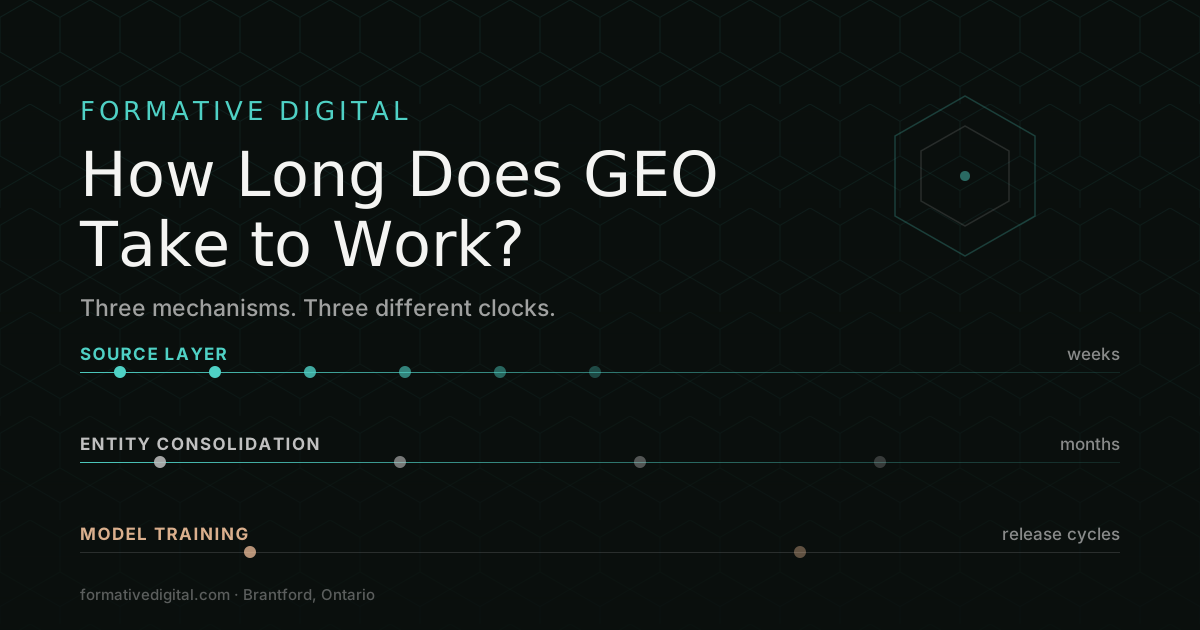
Quick Answer: GEO has no single timeline because three separate mechanisms run at different speeds. Source-layer fixes surface in AI answers within weeks, since retrieval is live. Entity consolidation takes months. Model-training effects wait for release cycles you cannot influence. Expect early citation movement in roughly four to twelve weeks.
Most agency answers to this question are a single number, and a single number is wrong the way an average is wrong: it describes something nobody actually experiences. What produces movement in AI answers is not one process on one schedule. It is three, running in parallel, separated by an order of magnitude.
| Mechanism | Typical window | What sets the pace | Your control |
|---|---|---|---|
| Source layer page content, structure, indexability |
Days to roughly 12 weeks | Recrawl and reindex cycles on the search index the assistant queries | High |
| Entity consolidation who you are, agreed across sources |
Roughly 3 to 12 months | Third parties publishing about you, plus corroboration across independent records | Partial and indirect |
| Model training what the model knows unprompted |
Whole release cycles | Vendor training runs and published knowledge cutoffs | Effectively none |
The awkward part becomes obvious on a second read. An owner sold "AI visibility" who expects a result in six weeks may have bought work that lives on the third row. Correcting that mismatch is what this page is for.
Why one number cannot be honest
An assistant answering a question about your business is not consulting one store of knowledge. Some of what it says comes from what the model absorbed during training. Some comes from documents it fetched seconds ago. Some comes from a structured record of your business that neither of those created on its own.
Those inputs update on completely different schedules. A page you publish tonight can enter a live retrieval index this month. A model's baseline knowledge was fixed before it shipped. The consensus about what your company is forms slowly, across records you do not own. Asking how long GEO takes without saying which of the three you mean is like asking how long a renovation takes without saying whether you mean the paint or the foundation.
The research supports the shape of the intervention without settling the timing question. Aggarwal and colleagues, the Princeton and Georgia Tech team that named the field, showed in their KDD 2024 paper that content-side changes such as adding statistics, quotations, and citations to authoritative sources can lift visibility in generated answers by up to 40 percent. That is well-evidenced about what moves. It says nothing about when, and no equivalent peer-reviewed timing study exists. Anyone quoting a precise week number is quoting an internal observation, not a finding.
Clock one: the source layer moves in weeks
The fastest lever is the one under your own hands, because retrieval happens at question time. An assistant searching mid-answer reads a current index, not a memory. Fix a thin page today and the corrected version can be the one that gets read, once the index catches up.
Google states the prerequisite plainly in its own AI features documentation: to be eligible to appear in generative AI features on Google Search, a page must be indexed and eligible to be shown in Google Search with a snippet. That single sentence dissolves a great deal of confusion. There is no separate AI pipeline you can enter directly. Ordinary indexing is the gate, and the gate has a queue.
How long the queue runs is partly yours to influence. Google's crawl budget documentation describes a crawl capacity limit that responds to your server: if the site responds quickly the limit goes up, and if it slows down or returns server errors the limit goes down and Google crawls less. The same page is blunt about what crawling guarantees, noting that not every page that is crawled will necessarily be indexed, and that after crawling each page must be evaluated, consolidated, and assessed to determine its suitability for the index. Crawl, index, eligibility, selection: four gates, each with its own delay, before an answer engine can quote you.
That is where the four-to-twelve-week band in the Quick Answer comes from. A clean site often sees new pages processed inside a week or two. A neglected one with slow responses and no internal linking takes far longer, and some pages never clear the fourth gate. If you are starting from scratch, our explanation of what GEO actually is covers the mechanics underneath.
The detail most timeline articles skip
Vendors run different crawlers for different purposes, and the distinction changes your timeline. OpenAI's documentation separates OAI-SearchBot, used to surface websites in search results in ChatGPT's search features, from GPTBot, which crawls to improve the foundation models themselves. They are governed independently in robots.txt, so a site can be readable for live search while excluded from training, or the reverse. Before concluding your work is slow, check you have not blocked the crawler responsible for the surface you are watching.
Clock two: entity consolidation moves in months
The second mechanism is slower because you are not the only author. Entity consolidation is how the systems answering questions come to agree on a stable understanding of who your business is: one name, one location, one category, one set of claims, corroborated in enough independent places that the answer is safe to repeat.
You can publish your own version of that record in an afternoon. You cannot publish anyone else's. Directory records, association listings, supplier pages, local news, review platforms, and the incidental mentions that accumulate around an active business all update on their own schedule, and the systems reading them refresh at their own pace on top of that. Entity work resists compression not because it is hard, but because it is distributed across parties who do not answer to you.
Two things follow. Businesses that consolidate fastest usually had a scattered but real footprint already, since the job is reconciliation rather than creation. Businesses that take longest are new ones with no record at all, because agreement cannot form around nothing. That asymmetry is the largest source of variance between two companies given identical work.
This maps to Vector 2: Anchor
Anchor handles entity validation: consistent business information across every surface, structured data stating the same facts in machine-readable form, and corroborating signals in places the answer engines already trust. It is the slowest vector by nature and the one clients most want to skip. Skipping it produces the frustrating middle period where content ships, rankings move, and assistants still describe you incorrectly.
A qualifier worth stating outright, since this is where expectations get abused: how quickly any of it lands depends on how contested your category is and how much public record already exists about you. Two businesses can receive identical work and see very different curves. That is not a hedge, it is the mechanism.
Clock three: model training moves on release cycles
The third mechanism is the one no agency can sell you, and the one most often quietly implied. An assistant answering from memory draws on a model whose knowledge was fixed at a training cutoff. Nothing published after that date exists in that memory until a later model is trained and released.
These dates are published. Anthropic lists a training data cutoff of January 2026 for its current Claude models, with the older Haiku 4.5 sitting at July 2025. The implication for an owner is direct: a company that opened in March 2026 is absent from those models' unprompted knowledge regardless of budget, effort, or website quality. The only route in is retrieval.
What we do not know, stated as what we do not know
- Documented: indexing is a prerequisite for Google's generative features, crawl capacity responds to server performance, vendors run separate crawlers for search and training, and current model knowledge cutoffs are published dates.
- Inference, not fact: that a citation earned today raises the odds of appearing in a future training run. Plausible, since public web content is training input, but no vendor publishes the criteria and no outside party can verify it. A reasonable bet, not a deliverable.
- Unknown outside these companies: how a given assistant weighs one source against another at answer time, and how often that weighting changes. Nothing is documented at that level, and honest practitioners say so rather than filling the gap with confident numbers.
Reasoning from that division is the discipline. Spend effort where the mechanism is documented and responsive. Treat the training layer as weather: real, consequential, not something you schedule around.
Why AI answers move on a different clock than Google rankings
Owners often notice something odd early on: an assistant describes the business accurately before the Google ranking for that topic has moved. Or the reverse, rankings improving while ChatGPT repeats something outdated. Both are normal, and the explanation is structural.
A Google ranking is a competitive position. To move up you have to displace somebody, and everybody above you is working too. A citation inside a generated answer is a selection problem rather than a displacement problem. Google's own documentation describes query fan-out as a set of concurrent, related queries generated by the model to request more information and fetch additional relevant search results, which turns one user question into many small retrieval problems. A page that answers one narrow sub-question cleanly can win that slot without ranking first for anything.
It cuts the other way too. Because selection happens per answer rather than per position, it is less stable. We break this down further in our comparison of GEO and SEO as separate disciplines, but the timeline consequence is simple: AI citations appear earlier and vanish more easily, while rankings arrive later and hold better.
What the slow clock looks like in real data
An Ontario shipping container dealer we work with shows the shape clearly: 4,810 clicks and 627,000 impressions in total, but single-digit daily clicks for most of the first year, including a sample day of 6 clicks against 1,682 impressions. By early summer 2026 the same property was recording seventy-click days with 6,000 to 9,000 daily impressions. Blended average position sat at 26.3, worth explaining rather than hiding: it mixes brand-new pages entering the index low with commercial pages climbing, so the average understates both. The lesson is the middle, not the ending. Nearly a year of impressions with almost no clicks is what compounding feels like from the inside. Source: Google Search Console, 16-month window, shared with permission.
That middle stretch is the normal experience of the process, not evidence it has failed. It is also what a failing engagement feels like, which is why measurement matters more than mood.
The surface you are measuring moves on its own
Here is the complication almost no timeline article admits: part of what you observe over your first six months has nothing to do with your work. Generated answers are recomputed on every request rather than cached, and the platforms change how often and how widely they cite.
The clearest published example comes from seoClarity, whose chief architect Mitul Gandhi tracked average citations per prompt in ChatGPT across five markets including Canada. Between February and April 2026 citation volumes fell by 86 to 94 percent, with sharp inflection points on March 8 and April 19. In May they rebounded toward pre-March levels. A business measuring its own progress that spring would have watched its citation count collapse and recover while its website did nothing unusual.
Two consequences. Never judge an engagement on a single spot check: one query on one day is a sample of one, drawn from a distribution that shifts weekly. And build the measurement before the expectation. Our guide to tracking AI citations properly covers the instrumentation. The discipline underneath is Vector 11, Measure: watch citation presence as a trend, with platform volatility treated as a known variable.
If you would rather see where you stand today than argue about how long it should take, our no-charge AI visibility audit reports what the assistants currently say about your business, correct or otherwise.
A twenty-minute self-check that tells you which clock you are on
Before accepting a timeline from anyone, including us, run this. Twenty minutes, and it tells you more than a proposal will.
Five questions, in this sequence
- 1. Are your pages indexed at all? Search Google for a distinctive sentence from your own page in quotation marks. If the page does not come back, nothing downstream can happen and your timeline has not started. That is a technical problem, not a content problem, and usually fixable in days.
- 2. Does the assistant search, or answer from memory? Ask ChatGPT or Perplexity your target question and watch whether it cites live links. Cited links mean clock one, and weeks are realistic. A confident answer with no sources means you are seeing model memory, which publishing this quarter will not alter.
- 3. Do independent sources agree on your basic facts? Check your business name, address, and phone number across your site, your Google Business Profile, and three directory listings. Disagreement means clock two has not begun converging, and months rather than weeks is the honest frame.
- 4. Is there any third-party record of you? Search your business name without your domain. If nothing exists that you did not publish yourself, you are in the cold-start case and expectations belong in quarters.
- 5. Have you blocked the crawler you are waiting on? Open your robots.txt and look for OAI-SearchBot, GPTBot, Google-Extended, and PerplexityBot. Ninety seconds, and the answer surprises people often enough to earn its place on this list.
Score it honestly. Failures at one and five are fast fixes with fast payoffs. A failure at three or four is a real project, and anyone promising six weeks on it is selling the fast clock to fund the slow one.
Get your free AI visibility audit
We will run the five checks for you and send back what ChatGPT, Perplexity, Gemini, and Google AI Overviews currently say about your business, plus which clock your situation is actually on. We send findings inside one business day, at no cost and with nothing owed afterward.
What cannot be promised, stated plainly
A timelines page that refuses to name its limits is just a longer sales pitch. Here is the boundary.
Nobody outside these companies can promise a date for a specific citation in a specific assistant. The selection logic is undocumented at that level, platforms revise it without announcement, and the seoClarity data above shows how much movement one revision produces. Nobody can promise inclusion in a future model's training data, because no vendor publishes those criteria. Nobody can compress clock two below the pace at which third parties publish.
What can be committed to is the work and the evidence of it: which pages ship, which structured data is deployed, which records get reconciled, and what the measurement shows month over month. That is an engineering commitment rather than a forecast dressed up as one.
Matt Griffin, Formative Digital: "The question behind this question is almost always 'when can I stop paying and start seeing something,' and it deserves a straighter answer than the industry gives it. I will not hand anyone a week number I cannot defend. What I will do is say which parts of the machine respond quickly and which do not. A pattern we see repeatedly in audits is an owner sold the slow layer on a fast timeline, then blaming themselves when month three looked flat. Truth not tricks has to include telling you which clock you are on."
One consequence for budgeting: because the clocks run simultaneously, the spend profile that works is steady rather than front-loaded. Paying heavily for three months and stopping captures only the first clock, which is also the least durable. The arithmetic is in our breakdown of what SEO should actually cost, and the same logic governs GEO retainers.
Formative Digital's Results Guarantee applies here in its exact form: if your existing domain shows no measurable organic search results after 12 months of work with Formative Digital, we work for free until you see them. It is scoped to existing domains, because new domains run on a longer clock for the reasons above.
Frequently Asked Questions
How soon will ChatGPT mention my business after I update my website?
It depends on which path the question takes. If the assistant runs a live search, your update can surface once the index it queries has recrawled the page, commonly days to a few weeks. If it answers from memory instead, your update was never consulted and waiting will not change that. OpenAI documents search crawling and training crawling as separate systems with separate crawlers, which is why no single answer fits.
Is GEO faster than SEO?
Half of it is faster and half of it is not. The retrieval layer can reflect a page change within weeks, which beats the climb to a stable top position on a contested Google query. The entity work underneath moves at the pace it always has, because it depends on other people publishing about you on their own schedule. Anyone selling GEO as uniformly faster is describing the fast half only.
Can I make AI assistants find my updated pages faster?
You can clear the obstacles, which is not the same as setting the pace. Confirm the page is crawlable and indexable, keep the server quick, submit an accurate sitemap, and check you have not blocked assistant crawlers in robots.txt. Google states that crawl capacity rises when a site responds quickly and falls when it slows or returns errors, so hosting quality is one of the few genuine speed levers an owner controls.
Why did my business vanish from an AI answer it used to appear in?
Generated answers are recomputed on each request rather than stored, so the source set can change while your page sits untouched. seoClarity measured ChatGPT citation volumes falling 86 to 94 percent across five markets between February and April 2026, then rebounding in May, which shows how much movement originates with the platform rather than any individual website. Judge your position on a trend across months, not one query on one afternoon.
Do I have to wait for the next model release to be included?
Only for the portion of an answer that comes from model memory. Anything retrieved live at question time skips training altogether, which is why the source layer is the practical place to spend effort. Anthropic publishes a training data cutoff of January 2026 for its current Claude models, so a business that opened after that date is not in that memory and has to be found by retrieval instead.
How long until this produces leads and not just citations?
Longer than citations, because a citation only begins a process the buyer finishes. A workable planning shape is one quarter of foundation work, a second quarter where citations and rankings compound, and enquiry volume trailing both. High-consideration trades produce fewer but larger enquiries, so measure by pipeline value rather than raw click count.
Sources
- Google (2026). AI features and your website: an optimization guide. Google Search Central documentation. Link
- Google (2026). Crawl budget management for large sites. Google Crawling Infrastructure documentation. Link
- Aggarwal, P., Murahari, V., Rajpurohit, T., Kalyan, A., Narasimhan, K., & Deshpande, A. (2023). GEO: Generative Engine Optimization. arXiv preprint 2311.09735, accepted to KDD 2024. Link
- OpenAI (2026). Bots: OAI-SearchBot, ChatGPT-User and GPTBot. OpenAI developer documentation. Link
- Anthropic (2026). Models overview: training data and knowledge cutoffs. Claude platform documentation. Link
- Gandhi, M. (2026, June 19). Tracking the decline of ChatGPT's citations. seoClarity. Link
Find out which clock you are on
Formative Digital, Brantford, Ontario
A timeline is only useful once you know your starting position. Run the five checks yourself, or send us the domain and we will walk you through what the assistants say today. Either way, begin from evidence rather than a number somebody quoted you.
Written by Matt Griffin, founder of Formative Digital, Brantford, Ontario. Published 2026-07-20.