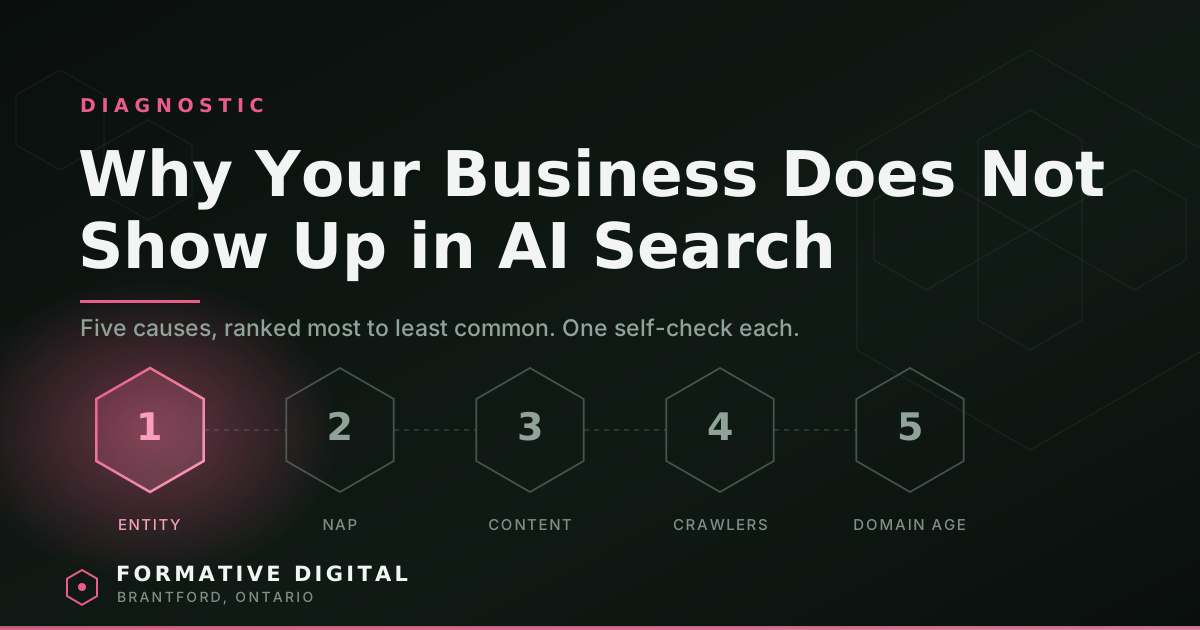
Quick Answer: Almost always because AI systems cannot find enough independent evidence that your business exists. In audits the usual order is: no mentions on third-party sites, then contradictory contact details, then pages that answer nothing, then blocked crawlers, and last, a domain that is too new to have accumulated any record.
That is the answer. The rest of this page helps you work out which of the five is yours, using checks you can run in an afternoon. No retainer, no phone call.
| # | Cause | The 60-second tell | Time to fix |
|---|---|---|---|
| 1 | No entity footprint off your own site | Search your exact business name. Every result on page one is a property you control. | Months |
| 2 | Thin or contradictory contact details | Your phone number or suite number differs across two directories. | Weeks |
| 3 | Nothing on the site is quotable | No page answers a question in a sentence a stranger could lift. | Weeks to months |
| 4 | You are blocking the wrong crawlers | Your robots.txt or firewall names a bot you cannot explain. | Days |
| 5 | The domain is genuinely too new | You registered it this year and nobody has written about you yet. | Months, unavoidably |
One honesty note about that table. The ordering is what we find repeatedly when auditing Ontario businesses that arrive with this complaint: a practitioner's frequency ranking, not a measured distribution from a controlled study. Nobody outside OpenAI, Google and Perplexity could produce one, because the retrieval layers are not published. Treat it as a search sequence, not a law.
The prerequisite Google states outright
Before any of the five causes matter, one condition has to hold for Google's surfaces. Google's AI optimization guide puts it in a sentence: to appear in generative AI features on Google Search, a page must be indexed and eligible to be shown with a snippet, meeting the standard technical requirements.
Read the second half again, because it catches people. Snippet eligibility is a separate switch from indexing. A page can be indexed perfectly and still be barred from AI Overviews because someone set a nosnippet directive, a max-snippet:0 robots meta tag, or a data-nosnippet attribute around the content you want quoted. Many were added during the 2024 and 2025 arguments over AI summarization and never removed.
Self-check: snippet eligibility
- View source on your top three pages. Search for
nosnippet,max-snippet,data-nosnippet. Any hit is a finding. - Run URL Inspection in Search Console on those pages. Confirm each reports as indexed.
- Search a distinctive sentence from the page in quotation marks. If Google cannot return the page for its own exact text, the question is settled.
Clear that gate first.
Cause 1: You have no entity footprint anywhere except your own website
This is the most common cause by a wide margin, and the one owners resist most, because the fix is not on their website. An assistant asked to recommend a business is running a verification problem, not a popularity contest. It needs corroboration: sources that are not you, saying you exist, do this work, and operate here. A site that is the sole publisher of every fact about itself gives it nothing to check.
Retrieval systems behave like a careful researcher who cannot confirm a claim: they reach for a competitor they can verify. We unpack how they assemble that evidence in where AI engines actually read from.
Matt Griffin, Formative Digital: "The first thing I check is never the website. It is whether anything on the open web mentions the business that the business does not own. A pattern we hit repeatedly is that the answer is no, not one thing, and that explains the silence better than any technical audit of their pages. You cannot schema your way out of being unmentioned."
Self-check: your off-site footprint
- Search your exact name in quotation marks. Count the page-one results you control. If that is all of them, this is your cause.
- Repeat it excluding your own domain. Append
-site:yourdomain.com. What survives is roughly what an assistant has to work with. - Ask the assistants directly. "What do you know about [business name] in [city]" into ChatGPT, Perplexity and Gemini. Note which sources they cite.
Fixing this is slow and unglamorous: trade associations, supplier and dealer listings, local chambers, industry directories that predate the AI era, local press, and review platforms where the review text describes what you do. None of it is a trick. It is the ordinary work of being a documented business, which most owners skipped because Google rankings never required it.
Cause 2: Your name, address and phone number disagree across the web
The second cause is a subset of the first and worse, because contradiction damages you more than absence. Three sources giving three different phone numbers is not three data points. It is a reason to lower confidence in all three and reach for a business whose record is clean.
There is a useful number here, with an equally useful caveat. SOCi's 2026 Local Visibility Index, published in January 2026 across roughly 350,000 locations and 2,751 multi-location brands, measured business profile accuracy at 68 percent on both ChatGPT and Perplexity, against 100 percent on Gemini, which draws on Google Maps directly. It found those brands in Google's local 3-pack 35.9 percent of the time, but recommended by ChatGPT only 1.2 percent.
Read that study carefully before you quote it
The SOCi index measured multi-location brands and franchise groups averaging roughly 67 locations each. It is not a measurement of independent single-location businesses, and presenting it as one would be dishonest. What it establishes is directional: strong Google local performance and AI recommendation rates come apart badly, and data accuracy tracks with visibility. Source: SOCi 2026 Local Visibility Index, via Search Engine Land, 28 January 2026.
Where this bites hardest is the detail nobody audits. A suite number on your website but missing from your Google Business Profile. A tracking number that appears nowhere else. A legal name that differs from your trading name everywhere else. Each is defensible alone. Together they make you look like several partially-described businesses instead of one well-described one. We covered the local case in AI recommendations versus Google Maps.
Self-check: consistency
- Write your canonical record once: legal and trading name, full address including unit, one phone number, one URL.
- Check it against six places: site footer, Google Business Profile, Apple Business Connect, Bing Places, and two industry directories.
- Flag every difference. "Street" versus "St." matters less than a wrong number, but resolve both. You are removing ambiguity, not just errors.
Cause 3: Your pages describe your business but never answer anything
Third cause, and the one most within your control this month. Most small business websites are brochures: who we are, what we value, why we care. Assistants are not answering "who are you". They are answering "who should I hire for X in Y", and they build that answer from passages they can lift. If no sentence on your site survives being pulled out of context, they have nothing to use.
This is where the academic work helps rather than decorates. Aggarwal and colleagues published the paper that named this discipline, GEO: Generative Engine Optimization, in November 2023. Testing against their GEO-bench benchmark, they reported visibility gains of up to 40 percent, strongest when content added quotations, statistics, and citations to authoritative references. Effect sizes varied by domain.
Worth stating what that does not mean. It is a 2023 paper measuring specific engines at a specific moment, and those engines have been rebuilt since. Nobody can promise you a 40 percent lift. What it supports is narrower and durable: verifiable specifics get selected more often than adjectives.
What a quotable passage looks like
Not quotable: "We pride ourselves on fast, reliable service across the region and treat every customer like family."
Quotable: "We service furnaces in Brantford, Paris and Cambridge, with same-day emergency callouts until 9pm on weekdays. Standard diagnostic is $129, waived if you proceed with the repair."
The second contains facts an assistant can attribute, compare against a competitor, and be held to. Put it under a question a customer would actually type and you have handed the machine both halves in one block.
Note what Google says about writing this content, because it contradicts much of what is sold as AI optimization. Its guide states you do not need to write in a specific way just for generative AI search. There is no secret register, only whether your page holds checkable information. For the model behind the tactic, see what GEO actually is.
Cause 4: You are blocking the crawlers that matter, and probably not the ones you think
Fourth cause. Less common than the first three, but the only one that can take you from fully visible to fully invisible overnight, and the most misdiagnosed. Each AI company runs several crawlers with different jobs, and blocking the wrong one has consequences nothing like what people expect. Everything below comes from first-party documentation, not inference.
| Crawler | Operator | What blocking it actually does |
|---|---|---|
Googlebot | Removes you from Google Search, and therefore from AI Overviews and AI Mode, which depend on the same index. | |
Google-Extended | Opts you out of Gemini model training and Gemini app grounding only. Google states it "does not impact a site's inclusion in Google Search nor is it used as a ranking signal in Google Search". | |
OAI-SearchBot | OpenAI | Removes you from ChatGPT search answers. OpenAI states that "sites that are opted out of OAI-SearchBot will not be shown in ChatGPT search answers". This is the one that matters for visibility. |
GPTBot | OpenAI | Opts you out of training foundation models. Does not remove you from ChatGPT search. |
ChatGPT-User | OpenAI | Handles user-initiated fetches. Because a person triggered the request, OpenAI notes robots.txt rules may not apply. |
PerplexityBot | Perplexity | Removes you from Perplexity search results. Perplexity states it is "not used to crawl content for AI foundation models". |
Perplexity-User | Perplexity | Visits pages to answer a specific user question. Perplexity states this fetcher "generally ignores robots.txt rules". |
Three consequences fall straight out of that table, and each contradicts advice we see published weekly.
First, blocking GPTBot does not make you invisible in ChatGPT. It is a training opt-out. Pages telling you to unblock GPTBot so ChatGPT will recommend you are handing you the wrong lever. Blocking GPTBot while allowing OAI-SearchBot keeps you out of training and fully visible in search.
Second, blocking Google-Extended does not hurt your Google Search or AI Overview presence. Google says so in its own crawler documentation. Publishers who blocked it in 2024 fearing ranking damage were guarding against a risk the documentation says does not exist.
Third, robots.txt is not the whole story. Two of the seven agents above are user-triggered fetchers that may bypass it entirely. Your real blocking may sit in a layer you never think about: a Cloudflare bot rule, a WAF ruleset, or a security plugin quietly returning 403s to unfamiliar agents. Robots.txt can be immaculate while your firewall refuses the connection.
Self-check: crawler access
- Open
yourdomain.com/robots.txt. Read every Disallow line. Check any agent you cannot explain against the table above. - Check your CDN and firewall separately. In Cloudflare, review Bot Fight Mode and custom WAF rules. Presets frequently catch AI search crawlers as collateral.
- Read your server logs for those agent strings and their status codes. A run of 403 or 429 to
OAI-SearchBotorPerplexityBotis your answer. - Confirm nothing blocks by IP. OpenAI and Perplexity publish their crawler IP ranges so you can allow them deliberately.
Of the five causes this is worth checking first despite ranking fourth, purely because it is cheap. Twenty minutes of reading configuration files either eliminates it or hands you an immediate fix.
Have us run the diagnosis instead
Rather not read your own firewall rules on a Tuesday night? Send us the domain. We will check all five causes, record what ChatGPT, Perplexity, Gemini and Google AI Overviews say about your business, and tell you which cause is yours. No charge, reply within one business day.
Cause 5: The domain is genuinely too new to have a record
Fifth and least common, but real, and it deserves an honest hearing rather than a sales answer. If you registered your domain a few months ago, nobody has written about you, and no directory carries you, there is no diagnostic mystery. The systems are behaving correctly. There is nothing to retrieve.
Two things follow. First, no amount of on-page work compresses this to zero. Corroboration requires other people, who move on their own timeline. Any agency promising to make a two-month-old domain a cited authority by next quarter is selling something it cannot deliver.
Second, and more encouraging: a foundation repair company we worked with started from a fresh domain with no search history, no reviews and no lead flow, and reached 30 leads inside the first three months (internal lead tracking, 2026). That is lead volume, not traffic, and it came from doing the entity and content work in the right order. Lead volume varies by trade and season; foundation repair is high-ticket, so 30 enquiries is a material pipeline there in a way it would not be everywhere. Our Results Guarantee covers existing domains only, because a new domain's timeline is not something we can honestly commit to.
Self-check: is it just age?
- Domain under twelve months old? Check the registration date on a WHOIS lookup, not memory.
- Fewer than ten reviews across all platforms? Review text is much of what assistants have to describe you with.
- Zero third-party mentions from Cause 1? If all three are true, age is genuine and the work is accumulation, not repair.
What is documented, what is inferred, and what nobody knows
The AI visibility field is full of confident claims with no basis behind them, so here is which category each thing on this page belongs to.
Documented, from first-party sources. Everything in the crawler table. Google's statements that snippet eligibility gates AI feature eligibility, that structured data is not required for generative AI search, and that it does not use llms.txt or any other machine-readable file you might be told to create.
Measured by third parties, with limits. The SOCi figures, valid for multi-location brands and not transferable to independents. The GEO paper findings, valid for the engines tested in 2023. Evidence, not laws of nature.
Genuinely unknown. The ranking function. How an engine weighs one corroborating source against another, its confidence thresholds, how often it refreshes its picture of you. None of that is public. We infer from observed behaviour and revise when the behaviour changes.
Recent work shows how unstable that layer is. Seo and colleagues published Verified Misguidance: Measuring Structural Citation Failures in Search-Augmented LLMs in May 2026, using 11,200 queries and 112,000 responses across ten models. They found 30.6 percent of citations distorted their sources. The finding most relevant to you: provider-level factors explained 88 to 96 percent of the variance in citation quality.
Why that number should change how you plan
If most of the variance comes from the provider's retrieval architecture rather than from properties of the documents, a large share of your outcome sits behind a wall you cannot reach. That is not a reason to do nothing. It is a reason to distrust anyone selling certainty, and to spend your effort on the part that is unambiguously yours: existing verifiably, describing yourself consistently, publishing things worth quoting.
This maps to Vector 1: Diagnose
Vector 1 of our 12 is Diagnose: establish what AI assistants say about a brand before changing anything. This page is that vector written out so you can run it without us. The AI visibility checker automates the first pass; the full methodology sits under our services.
Running the whole diagnosis in one sitting
Sequence matters, and it is not the frequency ranking. Go cheapest first, so you do not spend three weeks on content while a firewall rule quietly refuses every crawler that matters.
The 90-minute diagnostic run
- 0 to 20 min, access: robots.txt, CDN bot rules, WAF, server log status codes. Tests Cause 4.
- 20 to 30 min, eligibility: snippet directives and Search Console indexing on your top three pages.
- 30 to 50 min, footprint: exact-name search,
-site:search, direct questions to three assistants. Tests Cause 1. - 50 to 70 min, consistency: canonical record checked against six sources. Tests Cause 2.
- 70 to 90 min, quotability: one liftable factual sentence on each of your top five pages. Tests Cause 3.
Whichever check fails first is where your effort goes.
Two failure modes to watch for. The first is fixing Cause 3 because writing is pleasant and the off-site work in Cause 1 is not. The second is deciding you are fine because one assistant answered once. Ask several engines, several times, phrased several ways.
Frequently Asked Questions
How long does it take to start showing up in AI search?
Nobody outside these companies can give you a reliable number, and anyone quoting one precisely is guessing. From the mechanics: crawler access problems resolve within days of the fix, because the engines simply re-fetch. Content and citation problems move on the order of months, because they depend on other people publishing about you. A brand-new domain with no third-party footprint is slowest of all.
Does blocking GPTBot stop my business appearing in ChatGPT?
No, and this is the most common mistake we correct. OpenAI documents GPTBot as the crawler for training foundation models. The crawler governing ChatGPT search answers is OAI-SearchBot, and OpenAI states that sites opted out of OAI-SearchBot will not be shown in ChatGPT search answers. Block GPTBot, allow OAI-SearchBot, and you stay out of training while remaining fully visible.
Do I need schema markup to show up in AI search?
Not according to Google. Its AI optimization guide states that structured data is not required for generative AI search and that there is no special schema.org markup you need to add. Schema still earns its place: it disambiguates your business as an entity, powers rich results, and removes ambiguity about your contact details. Treat it as clarity, not an entry ticket.
My business ranks well on Google, so why do AI assistants ignore it?
Because they are separate selection problems. SOCi's 2026 Local Visibility Index, covering roughly 350,000 locations across 2,751 multi-location brands, found those brands in Google's local 3-pack 35.9 percent of the time but recommended by ChatGPT only 1.2 percent. Ranking gets you into the candidate pool. Being verifiable, consistent and quotable gets you selected out of it.
Sources
- Google (2026). AI optimization guide: how to succeed in Google's AI experiences. Google Search Central documentation. Link
- Google (2026). Google crawlers and user-triggered fetchers, including Google-Extended and GoogleOther. Google Search Central documentation. Link
- OpenAI (2026). OpenAI crawlers and user agents: OAI-SearchBot, GPTBot, ChatGPT-User, OAI-AdsBot. OpenAI developer documentation. Link
- Perplexity (2026). PerplexityBot and Perplexity-User crawler documentation. Perplexity developer documentation. Link
- Aggarwal, P., Murahari, V., Rajpurohit, T., Kalyan, A., Narasimhan, K., & Deshpande, A. (2023). GEO: Generative Engine Optimization. arXiv preprint arXiv:2311.09735, later published at KDD '24. Link
- Seo, Y., Jeong, W., Kim, E., Jang, H., & Lee, D. (2026). Verified Misguidance: Measuring Structural Citation Failures in Search-Augmented LLMs. arXiv preprint arXiv:2605.28565, 27 May 2026. Link
- Goodwin, D. (2026, January 28). AI local visibility is up to 30x harder than ranking in Google: Report. Search Engine Land, reporting the SOCi 2026 Local Visibility Index. Link
Find out which cause is yours
Formative Digital, Brantford, Ontario
The five checks above are the same ones we run, in the same order. Do them yourself and you will know where you stand. Or ask us and we will run them on your domain with the evidence attached. Either route ends with you knowing the cause, which is the only thing worth paying for at this stage.
Request your free AI visibility audit or call us on 226-450-2065.
Written by Matt Griffin, founder of Formative Digital, Brantford, Ontario. Published 2026-07-20.