Quick Answer: Most small businesses should pay attention, not panic. Your exposure depends on the queries that bring you customers, not on your industry. Pew Research found AI summaries on 8% of one-word or two-word searches but 53% of ten-word-plus searches. Long research questions mean urgency; short local ones buy you time.
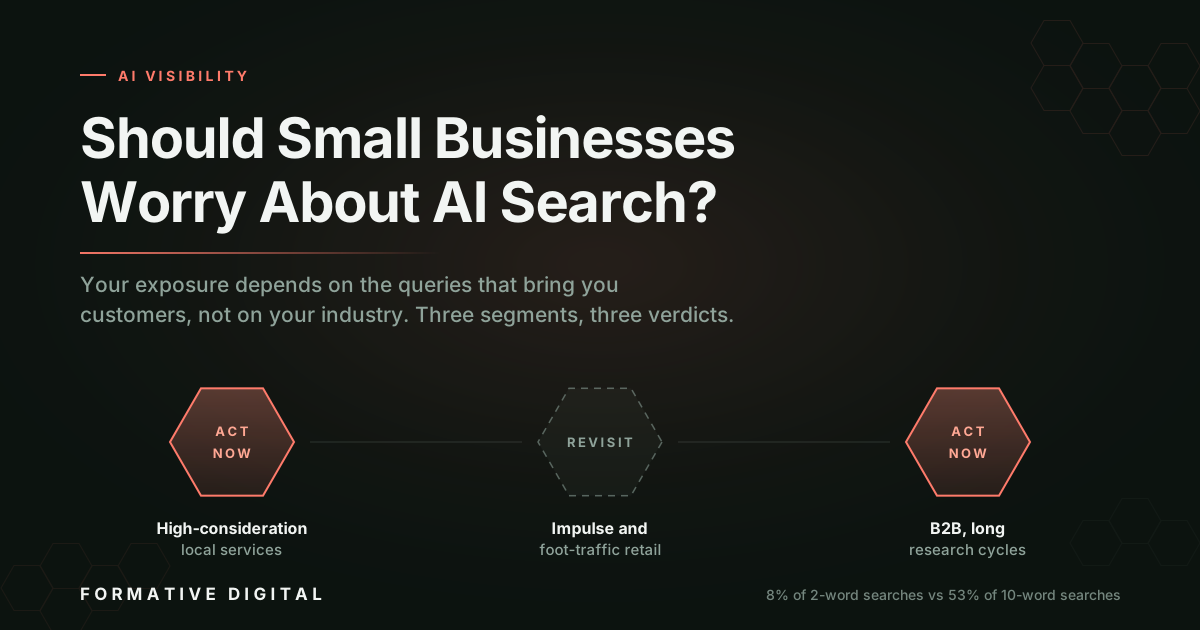
You have probably been told, several times this month, that you are behind. The email subject lines are getting shorter and the deadlines in them are getting closer. So here is the segmentation before the argument, and you can stop reading after the table if that is all you needed.
| If your business is | Customers typically find you by | Current AI answer exposure | Verdict |
|---|---|---|---|
| A high-consideration local service (foundation repair, law, dentistry, roofing, accounting) | Long questions about cost, cause, risk and process, asked weeks before they phone anyone | High and rising | Act now |
| Impulse or foot-traffic retail (cafe, corner shop, salon, takeaway) | Short local and branded searches, maps, walking past, word of mouth | Lower today, climbing | Maintain, revisit in six months |
| B2B with a long research cycle (manufacturing, software, equipment, professional services) | Comparison and specification questions, often several people researching in parallel | Highest of the three | Act now |
Three verdicts, not one. That is the part the panic marketing removes, because a segmented answer is harder to sell against than a universal emergency.
Why the honest answer starts with a question about your customers
AI search exposure is not distributed by industry. It is distributed by the shape of the search that brings someone to you, and that is a measurable thing rather than an opinion.
The most methodologically transparent public dataset on this is Pew Research Center's July 2025 study. Pew recruited 900 US adults who consented to a browser tracker, then recorded every Google search they made in March 2025: 68,879 unique searches, of which 12,593 produced an AI summary. Because Pew captured the actual queries rather than surveying people about their habits, the data can be cut by query length, and that cut is the useful one.
Searches of one or two words produced an AI summary 8% of the time. Searches of ten words or more produced one 53% of the time. Question-phrased searches produced one 60% of the time. Across the whole sample, 18% of searches generated a summary at all.
The number that reframes the question
A six-fold gap in AI summary exposure between short searches and long ones (8% versus 53%, Pew Research Center, March 2025 data) means two businesses of identical size in identical towns can face completely different risk. The variable is not what you sell. It is how much someone needs to know before they buy it.
Industry trigger-rate tracking through 2026 points the same way from a different angle. Informational searches generate AI Overviews at roughly 36% to 39%, while transactional searches sit around 5% and navigational ones around 12%. Comparison searches in an "X versus Y" form are the strongest trigger of all, reported above 95%. Those figures come from third-party scrapers running sampled keyword sets, so treat them as directional rather than exact, but the ordering is consistent across every tracker that publishes: the more a search looks like research, the more likely an AI answers it before you get the chance.
Matt Griffin, Formative Digital: "The question I get in almost every first call is some version of are we too late. Almost nobody asks the question that actually decides it, which is what does a customer type before they find us. A pattern we see repeatedly in audits is two businesses on the same street with completely different exposure, because one gets found on a three-word search and the other gets found on a paragraph. Same town, same size, different clock."
The three segments, and which one you are in
Work out which description below fits the way people actually reach you. If you are unsure, open Google Search Console, sort your queries by impressions, and read the top thirty. The average word count of that list is your answer.
High-consideration local services: act now
Foundation repair, family law, dentistry, roofing, HVAC, bookkeeping. What these have in common is not the trade, it is the customer's mental state. Nobody wakes up wanting a underpinning quote. They notice a crack, they get frightened, and they spend two weeks asking questions like "is a stair-step crack in a block wall serious" and "how much does foundation repair cost in Ontario" long before they type a company name. Every one of those is a long, question-shaped search, which is precisely the search that produces an AI answer at a 53% to 60% rate.
The consequence is specific. Your prospect forms their entire understanding of the problem, the price range, and the shortlist criteria inside an AI answer you were either cited in or absent from. By the time they search your category commercially, the frame is set. That is why the trades keep reporting that leads arrive better-informed and further along than they used to, which is a real effect noted across the industry.
This is also the segment where a properly built content foundation moves fastest. One anonymized engagement we published as a case study involved a brand-new foundation repair company on a fresh domain, no search history and no review base, which went from zero to 30 leads inside the first three months (internal lead tracking, 2026). Lead volume varies enormously by trade, market and season, and foundation repair is a high-ticket category where 30 enquiries is a material pipeline in a way it would not be for a cafe. The transferable point is not the number. It is that the questions preceding a purchase are documented, findable, and answerable, and almost nobody in these trades has answered them properly.
Impulse and foot-traffic retail: lower urgency, and that is not the same as none
A cafe, a barber, a corner grocery, a nail salon. Your customers find you through maps, through proximity, through a friend, and through short searches that name a category and a place. Those searches trigger AI answers least often, and when an assistant does answer a "coffee near me" style question it typically pulls from Google Business Profile data rather than from your website copy.
So the honest advice for this segment is deflationary: keep your Google Business Profile accurate and complete, keep your name, address, phone number and hours identical everywhere they appear, collect reviews at whatever pace is natural, and do not buy an AI search retainer this quarter. Spend the money on the thing that actually moves a foot-traffic business.
The caveat matters though, and it is why the verdict says revisit rather than ignore. Through 2025, AI Overview trigger rates on the search types that protect this segment rose sharply from low bases: commercial searches climbed from roughly 8% to 19%, transactional from about 2% to 14%, navigational from under 1% to 10%. Those are large multiples on small numbers. The gap between segments is closing, and a reasonable planning assumption is that it keeps closing rather than holding still.
B2B with long research cycles: act now, and probably first
If you sell equipment, components, software, or professional services into other businesses, your buyers produce the longest and most specification-dense searches on the internet, and they frequently run comparison searches, the single highest AI-answer trigger category measured. They also research in committees, which means several people are independently forming impressions of you through generated answers before anyone contacts you.
There is a compounding characteristic here worth understanding. B2B categories are usually low-volume and unglamorous, which means very few competitors have bothered to publish real technical answers, which means the citation opportunity is unusually open. Our anonymized Ontario container dealer case documents what that compounding looks like over a 16-month window in an unglamorous high-ticket vertical, including the long flat stretch at the start that most owners quit during.
What nobody outside these systems actually knows
This section exists because the rest of this page would be dishonest without it. Ranking and citation systems inside Google, OpenAI, Anthropic and Perplexity are closed. Nobody outside those companies can tell you with certainty how a source gets selected for a generated answer, and any page that speaks with total confidence about the internals is either guessing or selling.
Here is what is genuinely established, and what is inference.
Established, inferred, and unknown
- Established: AI summaries appear on a substantial and growing share of searches, at rates that differ sharply by query length and type. Multiple independent trackers plus Pew agree on the direction and rough magnitude.
- Established: Clicks to traditional results are lower on searches where a summary appears. Pew measured 8% versus 15%.
- Inference, not proof: that AI summaries cause the click reduction. Pew explicitly frames this as correlation. The queries that trigger summaries are also, by definition, the more question-like queries, and those may always have converted to clicks differently.
- Contested: Google's public position. Asked about the Pew findings in July 2025, a Google spokesperson said the study "uses a flawed methodology and skewed queryset that is not representative of Search traffic", and stated Google had not observed significant drops in aggregate web traffic. Google did not publish counter-data.
- Unknown: how any specific assistant weights a specific source. Also unknown: how fast trigger rates will move, and whether current patterns survive the next model generation.
Sit with the Google response for a second, because it is instructive rather than merely defensive. Both things can be true: aggregate clicks across the whole web can hold steady while clicks to informational pages in specific categories fall hard. Aggregates hide distribution. If you are a small business in a research-heavy category, the aggregate is not the number that governs your outcome, and neither Google's statement nor Pew's finding tells you what is happening to you. Your own Search Console data does.
We wrote about the measurement side of this at length in our study of zero-click search and what it does to local businesses, which gets into how to read the impression-versus-click divergence in your own account rather than in somebody's headline.
Naming the manipulation in the marketing you are being sent
You are being marketed to with a specific rhetorical structure, and it is worth being able to see it, partly so you can evaluate this page by the same standard.
The unsourced number. The page currently ranking first for this exact question cites three statistics, including that more than 35% of consumers have used an AI tool to find a local business and that 88% of local businesses have no AI search strategy. Neither figure carries a source, a date, a sample size, or a methodology. They may well be roughly right. You have no way to check, and that is the point of publishing them that way.
The aggregate applied to the individual. A statistic drawn from informational searches gets presented as a fact about all searches, and therefore about your business. The 53% figure in this article is real, and it describes ten-word-plus searches specifically. Used carelessly, it becomes "half your traffic is gone", which it does not say.
The invented deadline. Nobody knows the timetable. Language like "before it is too late" and "the window is closing" performs a certainty that does not exist, and its function is to compress your decision time so you buy without comparing.
The product that does nothing. The clearest current example is the llms.txt file, sold in packages as AI search readiness. Google's own AI optimization documentation states that you do not need to create new machine readable files, AI text files, markup or Markdown to appear in Google Search, and that Google Search ignores them. The same document says structured data is not required for generative AI search and there is no special schema.org markup to add, and that there is no requirement to break your content into tiny pieces for AI to understand it. Three products, sold widely, that the vendor of the search engine has said in writing it does not use.
None of this means the underlying shift is fake. It means the urgency is being manufactured on top of a real trend, which is the harder situation to think clearly in. If a proposal in your inbox uses two or more of the four patterns above, that is not proof the provider is dishonest, but it is a reason to ask for the sources before you ask for the price. Our teardown of a $3,000 SEO package takes one real proposal apart line by line if you want to see the anatomy.
A five-question self-check you can run this afternoon
No tools required beyond a browser and your Search Console login. Answer honestly; the result tells you which of the three verdicts applies to you specifically rather than to your category on average.
Run these five and count your yeses
- 1. Query length. Open Search Console, sort queries by impressions, read the top thirty. Are most of them five words or longer? A yes means higher exposure.
- 2. Research gap. Between a customer first noticing their problem and contacting you, does more than a week usually pass? A yes means higher exposure.
- 3. The assistant test. Ask ChatGPT, Perplexity and Google's AI mode the three questions a customer asks before they buy from you. Are you named or cited in any answer? A no means higher exposure.
- 4. The accuracy test. In the same answers, is what the assistants say about your business, hours, service area and speciality actually correct? A no means you have a factual record problem, which is more urgent than a ranking problem and cheaper to fix.
- 5. The substitution test. Could a competent generated paragraph answer your customer's question well enough that they never need to visit anyone's website? A yes means higher exposure.
Three or more high-exposure answers puts you in the act-now group regardless of what industry you thought you were in. Zero to one puts you in maintain-and-revisit. Two is genuinely ambiguous, and the honest recommendation there is to fix your factual record, publish answers to your five most-asked customer questions, and re-run the check in six months rather than signing anything.
If you would rather not run it yourself, we will run the assistant checks for you and send back what we find.
What Google itself says to do about it
Given how much contradictory advice is circulating, the most useful thing a small business owner can read is the primary source. Google publishes an AI optimization guide in its Search Central documentation, and its recommendations are notably unexciting.
The guidance reduces to three things: create valuable content that is not commodity material, with a genuine point of view and original information; build clear technical structure so pages can be crawled and indexed; and focus on whether visitors are satisfied rather than on what you imagine the algorithm wants. Google's own phrasing is to "apply SEO best practices to generative AI search" and to "continue prioritizing foundational SEO best practices".
This maps to Vector 3: Resonate
The third of Formative Digital's 12 Vectors is Resonate: identifying the questions prospects actually ask assistants, rather than the keywords a tool suggests, and mapping intent across both surfaces. This entire article is a Resonate argument. The urgency question cannot be answered from your industry code; it is answered from your query mix, which is why the first step of every engagement we run is reading the real questions rather than the keyword report. If you want the discipline explained from first principles, our definition of GEO covers the research base.
There is a reason the official guidance sounds boring. The mechanics that make a page usable by a generative system are largely the mechanics that made it usable by a human reader and a classical crawler: clear claims, verifiable facts, structure a machine can parse, and an identifiable author. What has changed is the reward curve, not the fundamentals. The peer-reviewed work supports that reading. Aggarwal and colleagues at Princeton, in the paper that named the field, measured up to 40% visibility improvement in generative answers from content changes, with the gains coming from adding statistics, quotations and cited sources, while classical keyword loading produced little to no improvement. Their other finding is the one most agencies skip: effectiveness varied by domain, so tactics that work in one category do not transfer cleanly to another.
If you are in the act-now group, what the first ninety days look like
Not a checklist to grind through in order, because the sequencing depends on what your audit turns up. These are the four workstreams that matter, roughly in the order they usually pay off.
Fix the factual record first. Before anything creative, make sure the machine-readable facts about your business are correct and consistent: name, address, phone, hours, service area, and what you actually do. Assistants build a picture of an entity from repeated agreement across sources. Contradictions do not average out, they lower confidence. This is unglamorous, it is often the cheapest thing on the list, and in audits it is the single most common thing we find broken.
Answer the pre-purchase questions properly. Write the five to ten questions your customers ask before they buy, and answer each one completely enough that a stranger could quote your answer and be right. Include the number, the range, the exception, and the circumstance where your answer does not apply. The honesty is not decoration; specificity is what makes a passage extractable, and hedged marketing prose is not extractable by anything.
Make the pages structurally legible. Real headings that state what a section answers, one clear claim per section, sources linked inline, an author with a name attached. Structured data helps rich results and is worth having, though note Google's position that it is not required for generative answers specifically.
Then measure the right things. Which brings us to the last section, because this is where most small businesses get quietly misled by their own dashboards.
Find out which segment you are actually in
We will run the five-question check against your business, look at how ChatGPT, Perplexity, Gemini and Google AI Overviews currently describe you, and tell you plainly whether this is urgent for you or not. If the answer is that you have time, we will say that instead. The write-up reaches you inside one business day, with nothing to pay and nothing to sign.
How to measure this without lying to yourself
Session count is now a poor proxy for commercial health, and clinging to it produces two opposite errors: panic when sessions fall for reasons that do not matter, and complacency when sessions hold while qualified enquiries dry up.
Three measurements that survive the shift. First, enquiries and their quality, tracked at the source, because a smaller number of better-informed prospects can outperform a larger number of browsers. Industry measurement of AI-referred visitors consistently finds longer sessions and higher conversion rates than classical organic traffic, with Semrush putting the value multiple at roughly 4.4 times and Adobe reporting materially lower bounce rates for retail. Treat the exact multiples as vendor-published rather than peer-reviewed, but the direction is corroborated across sources.
Second, the impression-to-click divergence in Search Console. Impressions rising while clicks flatten is the signature of your content being read and summarized rather than visited. That is not automatically a loss, and it is definitely information.
Third, citation presence. Ask the assistants the questions your customers ask, on a schedule, and record whether you are named and whether the description is accurate. It is a manual, slightly tedious measurement and it is the closest thing available to a direct read on the surface everyone is worried about.
The Ontario context
Canadian small businesses are not starting from zero here. Statistics Canada's Survey of Digital Technology and Internet Use found 89% of Canadian businesses had at least one form of web presence in 2021, with company websites the most commonly reported form at 78%. The gap for most Ontario owners is not whether a website exists. It is whether it answers the questions customers ask before they buy, in language a machine can extract, with the business facts stated consistently enough to be trusted. That is a content and structure problem, not a rebuild.
One qualifier before you plan anything around this. How quickly any of it moves depends on your trade, your local competition, and what is already published under your name. Timelines in this work run in months rather than weeks, and a brand-new domain runs slower than an established one. Anyone offering you a guaranteed AI citation is describing something the closed nature of these systems does not permit. If you want the ground-level version of all of this without the strategic framing, our beginner's guide to AI SEO is the gentler entry point, and the primary-source teardowns in our research hub go the other direction into the documentation itself.
Frequently Asked Questions
Is AI search actually taking traffic from small businesses?
The best public evidence says clicks fall when an AI summary is present, but it stops short of proving cause. Pew Research tracked 900 US adults across 68,879 Google searches in March 2025 and found users clicked a traditional result on 8% of visits where a summary appeared, against 15% where none did. Pew notes this is a correlation. Google called the queryset unrepresentative. Both statements can be true at once.
Which small businesses should act on AI search first?
Businesses whose customers research before buying. High-consideration local trades such as foundation repair, law, dentistry and roofing, plus B2B sellers with long evaluation cycles, both attract long question-shaped searches, and those are the searches that generate AI answers most often. If a typical customer reads for two weeks before phoning you, you are in the act-now group.
Can I ignore AI search if my customers find me on Google Maps?
Ignore is too strong, but you have more time than the marketing suggests. Short local and navigational searches produce AI answers far less often than long research questions. Keep your Google Business Profile accurate, keep your hours and phone number consistent everywhere, and revisit the question in six months. The trigger rates for short commercial searches climbed through 2025, so this is a reprieve rather than an exemption.
Do I need an llms.txt file or special AI markup?
No. Google's own AI optimization documentation states plainly that you do not need to create new machine readable files, AI text files, markup or Markdown to appear in Google Search, and that Search ignores them. The same page says structured data is not required for generative AI search and there is no special schema.org markup to add. Anyone selling you an llms.txt file as an AI search product is selling a file Google has said it does not read.
How long do I have before this becomes urgent for everyone?
Nobody outside Google can answer that with precision, and anyone who names a date is guessing. What the tracking data shows is direction rather than a deadline: through 2025, AI Overview trigger rates on commercial, transactional and navigational searches all rose several times over from very low starting points. Plan on the assumption that the gap between segments narrows, not that it holds.
Is it worth paying an agency for AI search work right now?
It depends on which segment you are in and what the agency actually ships. If your customers arrive on long research questions, the work pays for itself sooner. Ask any provider to name the artifacts you will receive each month and how success gets measured before you sign. A proposal that lists activities rather than deliverables is the oldest warning sign in this industry.
Sources
- Pew Research Center (2025). Google users are less likely to click on links when an AI summary appears in the results. Pew Research Center Short Reads, 22 July 2025. Link
- Google (2025). AI features and your website: an AI optimization guide. Google Search Central documentation. Link
- Schwartz, B. (2025). Google's AI Overviews are hurting clicks: Pew study, including Google's response. Search Engine Land, 24 July 2025. Link
- Aggarwal, P., Murahari, V., Rajpurohit, T., Kalyan, A., Narasimhan, K., & Deshpande, A. (2023). GEO: Generative Engine Optimization. arXiv preprint 2311.09735, accepted to KDD 2024. Link
- Statistics Canada (2022). Digital technology and Internet use, 2021. The Daily, 13 September 2022. Link
- Semrush (2026). AI SEO statistics, including AI visitor value multiples and referral traffic growth. Semrush Blog. Link
Get a straight answer about your own business
Formative Digital, Brantford, Ontario
The worst outcome of the current noise is a business owner spending money out of fear, or ignoring a real shift because the marketing around it was insulting. We will look at your actual query mix and tell you which of the three verdicts applies to you. Sometimes that answer is that you have time.
Written by Matt Griffin, founder of Formative Digital, Brantford, Ontario. Published 2026-07-20.