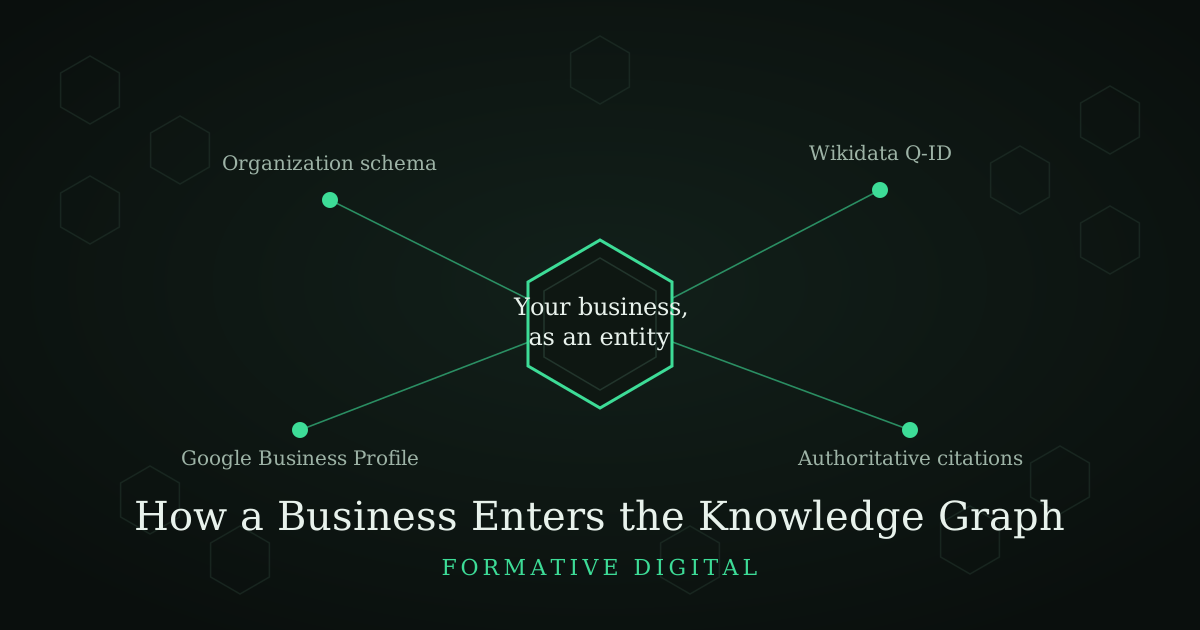
Quick Answer: You get into Google's Knowledge Graph by making independent sources agree about your business: Organization schema with sameAs links, a claimed Google Business Profile, consistent NAP, a Wikidata record, and citations from authoritative publications. Google corroborates entities across sources, so most businesses wait three to nine months for a panel.
There is no application form for the Knowledge Graph. That single fact explains why so much advice on this topic is vague. You cannot submit your business, you cannot pay for inclusion, and no agency can promise a panel by a given date. What you can do is understand the mechanism Google uses to decide that an entity exists, then feed that mechanism deliberately. This guide lays out the sequence we run for clients, grounded in the academic literature on knowledge graphs rather than in folklore, and it tells you honestly where the timeline stops being under your control.
What the Knowledge Graph actually is
The Knowledge Graph is Google's database of things rather than pages: people, places, organizations, products, and the relationships between them. The definitive academic treatment is Hogan et al.'s 2021 survey, which defines a knowledge graph as "a graph of data intended to accumulate and convey knowledge of the real world" (Hogan et al., 2021, arXiv:2003.02320). Nodes are entities. Edges are facts connecting them: this company is located in this city, was founded by this person, operates in this industry.
Google announced its version in 2012, and the idea spread quickly; Hogan et al. document parallel knowledge graphs at Amazon, Microsoft, LinkedIn, Facebook, and eBay, which matters here because the discipline you build for Google's graph feeds the others too. By Google's own 2020 accounting, the graph held some 500 billion facts about five billion entities. When you search a brand and a panel appears on the right side of the results, you are looking at a rendered entity record. When Gemini describes a company in a generated answer, it is drawing partly on the same substrate.
The concept that does the real work for a business owner is what the survey calls identity: "identity denotes which nodes in the graph refer to the same real-world entity" (Hogan et al., 2021). Getting into the Knowledge Graph is, at bottom, an identity problem. Google must become confident that the name on your website, the listing on Maps, the LinkedIn company page, and the mention in a trade publication all describe one specific real-world thing, and that this thing is distinct from every similarly named thing on Earth.
How Google decides your entity exists
Google's own Knowledge Panel documentation describes the graph as assembled automatically from a wide range of public and licensed sources, with information corroborated across them. No single source creates an entity. Agreement between sources does. This is the engineering insight the whole process hangs on, and it maps directly to Vector 2 of our 12 Vectors methodology, Anchor: establish the entity by making every machine-readable statement about your business match every other one.
Think of it as a court that only accepts independent witnesses. Your website testifying about itself is one witness with an obvious interest. Your schema markup is that same witness speaking more clearly. The Business Profile, the Wikidata item, the chamber of commerce listing, the news article: each is an additional witness, and their testimony only counts if it matches. A business whose sources disagree about its own name is not a candidate for an entity record; it is an unresolved ambiguity, and unresolved ambiguities get left out of the graph.
Matt puts it this way after years of running these audits: "The most common blocker I find is not missing schema. It is three sources telling three different stories. The website uses the legal name, the Business Profile uses the trading name, and the directories carry an address from two moves ago. Google is not going to pick a winner for you. Until you make the record agree, the machine treats you as noise." That pattern repeats across nearly every Ontario service business we assess, regardless of industry.
Step one: make every source tell the same story
Before any markup, fix NAP consistency: name, address, phone. Choose one canonical form of the business name and use it everywhere, character for character. Decide whether you are "Smith & Sons Roofing Ltd." or "Smith and Sons Roofing" and never mix them again. Audit the places your business is already described: your own site footer, Google Business Profile, LinkedIn, Facebook, industry directories, the local business association. Correct every variant.
This step is unglamorous, which is why agencies skip it in favour of flashier deliverables. It is also the highest-yield work in the entire sequence, because every later signal inherits its value from this agreement. A perfect Wikidata item pointing at a Business Profile with a mismatched name adds ambiguity instead of removing it.
Step two: publish Organization schema with sameAs links
Organization schema is your entity's formal, machine-readable statement of identity. It belongs on your homepage as JSON-LD, and its most underused property is sameAs: an array of URLs identifying the same entity elsewhere. Each sameAs link is you handing Google a pre-verified witness list, which shortens the corroboration work considerably. A minimal version looks like this:
<script type="application/ld+json">
{
  "@context": "https://schema.org",
  "@type": "Organization",
  "@id": "https://example.ca/#organization",
  "name": "Smith and Sons Roofing",
  "url": "https://example.ca",
  "logo": "https://example.ca/logo.png",
  "telephone": "+15195551234",
  "address": {
    "@type": "PostalAddress",
    "streetAddress": "12 King Street",
    "addressLocality": "Brantford",
    "addressRegion": "ON",
    "postalCode": "N3T 3C9",
    "addressCountry": "CA"
  },
  "sameAs": [
    "https://www.linkedin.com/company/smith-sons-roofing",
    "https://www.facebook.com/smithsonsroofing",
    "https://www.wikidata.org/wiki/Q000000000"
  ]
}
</script>
The @id gives your entity a stable address other schema on your site can reference, so your Article and Service markup all point at one Organization node instead of redeclaring it. We keep a fully annotated version, property by property, in our Organization schema example if you want a copy-paste starting point with every field explained.
Step three: use Wikidata as a disambiguation tool, not a shortcut
Wikidata is the largest open knowledge graph, built by volunteers and identified by Hogan et al. as one of the most prominent public graphs in existence. Google reads it. So do the pipelines behind several AI assistants. A Wikidata item gives your business a Q-identifier, a permanent machine-readable ID that settles the "which Smith Roofing?" question in one stroke.
Our position, argued at length in our research piece on Wikidata as AI truth infrastructure, is that Wikidata is tactical, not foundational. It disambiguates; it does not confer authority. Create an item with your canonical name, official website, headquarters location, industry, and founding date, and reference it from your sameAs array. Follow Wikidata's notability norms honestly: cite independent sources for every claim, and accept that a promotional item with no references may be deleted, which wastes the effort. One clean, boring, well-referenced item outperforms an ambitious one that gets challenged.
Step four: claim and complete your Google Business Profile
For a local business, the Business Profile is the fastest entity signal available, because it is data you hand Google directly, under a verification process Google itself controls. Claim it, verify it, and complete every field with the same canonical NAP you settled in step one. Categories matter more than most owners realize: they are typed edges in the graph, formal statements that your entity belongs to a class of businesses.
Note the relationship honestly: the panel that appears when someone searches a local business by name is usually rendered from the Business Profile first. The deeper Knowledge Graph record, the one the API can see and AI systems draw on, builds up behind it as the other signals accumulate. The two reinforce each other, and treating the profile as a one-time setup task rather than a maintained asset is a standing mistake we see in audits.
Step five: earn citations that describe you the same way
Corroboration needs witnesses Google did not get from you. That means coverage and listings on sources with their own editorial standards: local news, trade publications, industry associations, chambers of commerce, supplier and partner pages, podcast show notes. The goal is not link equity in the classic SEO sense. The goal is repeated, consistent, third-party description of your entity: same name, same city, same line of business.
When you pitch or supply information for any of this coverage, provide your canonical name and description so the published version matches your record. A dozen modest citations that agree are worth more for entity recognition than one prestigious mention that spells your name differently.
Get your free AI visibility audit
We will check whether your business already holds a Knowledge Graph record, test what ChatGPT, Perplexity, Gemini and Google AI Overviews currently say about you, and map exactly which corroborating signals are missing. No charge, no obligation, a reply within one business day.
How to check whether you are in
Two tests, one visible and one technical. The visible test: search your exact business name in an incognito window. A panel on the right side of desktop results, showing your name, category, and details you did not pay to place there, is a rendered entity record. For local businesses, check whether the panel content goes beyond what your Business Profile supplies; extra facts signal a maturing graph entry.
The technical test is more precise. Google publishes the Knowledge Graph Search API at kgsearch.googleapis.com. With a free API key from Google Cloud, request:
https://kgsearch.googleapis.com/v1/entities:search
  ?query=YOUR+BUSINESS+NAME&key=API_KEY&limit=5&indent=true
A JSON response containing your business with a machine ID beginning /g/ or /m/, plus a result score, confirms you hold a record. Run the query quarterly and watch the score; rising confidence over time is the clearest progress metric this work has. Google flags the API as read-only and not production-critical, so treat it as a diagnostic instrument, not a dashboard feed. This measurement habit is Vector 11 in practice: track what the machine believes, not just where you rank.
What an entity record does for AI answers
The payoff extends well past the panel. Google has stated that its Gemini models and AI Overviews draw on Knowledge Graph data when assembling responses, which means a confirmed entity gets described from a vetted fact base instead of whatever the model half-remembers from training data. In our testing across client brands, businesses without entity records are where the strangest AI descriptions show up: wrong cities, merged identities with similarly named companies, defunct services presented as current.
An entity record is the difference between an AI answering from your record and guessing about your existence. That is why entity work sits at the front of our entity optimization service rather than at the end: content strategy built on an unconfirmed entity is a house built on sand. For the wider strategic picture of what the graph means for a business, our Knowledge Graph business guide covers the research foundations in depth, and the rest of our research library traces how these systems select what to cite.
Realistic timelines, stated plainly
Here is the honest schedule. The controllable work, steps one through five, takes two to eight weeks depending on how messy your existing citations are. Recognition is then Google's decision on Google's clock. Industry observation and our own client experience both put typical entity recognition at three to nine months after consistent signals are in place. Niche names resolve faster because there is nothing to disambiguate. Businesses sharing a name with a larger brand sit at the slow end, and a few never receive a standalone panel even with a confirmed API record, because panel display is a separate rendering decision Google makes per query.
Anyone quoting you a guaranteed panel date is selling something the mechanism does not permit. What a practitioner can legitimately promise is the input side: full corroboration, verified via the API, with progress measured quarterly. Results vary by industry and by how contested your name is; that qualifier is not hedging, it is how the system actually behaves.
Frequently Asked Questions
How long does it take to get into Google's Knowledge Graph?
Most businesses that put consistent signals in place see an entity record within three to nine months. Niche entities with little name competition tend to be recognized faster; businesses sharing a name with a bigger brand take longer because Google has to resolve the ambiguity first. There is no submission form and no way to pay for inclusion.
Do I need a Wikipedia page to get a Knowledge Graph entry?
No. Wikipedia accelerates recognition because it is one of the corroborating sources Google trusts most, but thousands of small businesses hold entity records without an article. A claimed Google Business Profile, Organization schema with sameAs links, and consistent third-party citations are enough for a local or regional business entity.
How do I check if my business is already in the Knowledge Graph?
Query the Knowledge Graph Search API at kgsearch.googleapis.com with your business name and a free API key from Google Cloud. If a result comes back with your name, description, and a machine ID starting with /g/ or /m/, you hold an entity record. Searching your brand name in Google and seeing a panel on the right side is the visible confirmation.
Does a Knowledge Graph entry help with ChatGPT and AI Overviews?
Yes, in two ways. Google states that Gemini and AI Overviews draw on Knowledge Graph data when assembling answers, so a confirmed entity is more likely to be described accurately. And the same disambiguated identity propagates through Wikidata into the training and retrieval layers of other assistants, which reduces the odds of an AI confusing you with a similarly named company.
Can a Canadian small business realistically get a knowledge panel?
Yes. In Matt Griffin's work with Ontario service businesses, local companies with a claimed Google Business Profile, clean Organization schema, and a handful of consistent directory and news citations regularly earn entity records. The panel that appears for branded searches of a local business is often fed by the Business Profile first, with the Knowledge Graph record deepening over time.
Sources
- Hogan, A., Blomqvist, E., Cochez, M., et al. (2021). Knowledge Graphs. ACM Computing Surveys / arXiv:2003.02320. Link
- Google (2020, May 20). A reintroduction to our Knowledge Graph and knowledge panels. The Keyword, Google Blog. Link
- Google Developers (accessed 2026-07-19). Knowledge Graph Search API documentation. Google for Developers. Link
- Google (accessed 2026-07-19). How Google's Knowledge Graph works. Knowledge Panel Help. Link
- Schema.org (accessed 2026-07-19). Organization type documentation. Schema.org. Link
Find out what the machine believes about your business
Formative Digital, Brantford, Ontario
If you have read this far, you already suspect your entity record is thin or absent. We can confirm it in a day: an API-level check of your Knowledge Graph status plus a scan of what four AI assistants currently say about you, with the missing corroboration signals ranked by effort. Request your free AI visibility audit.