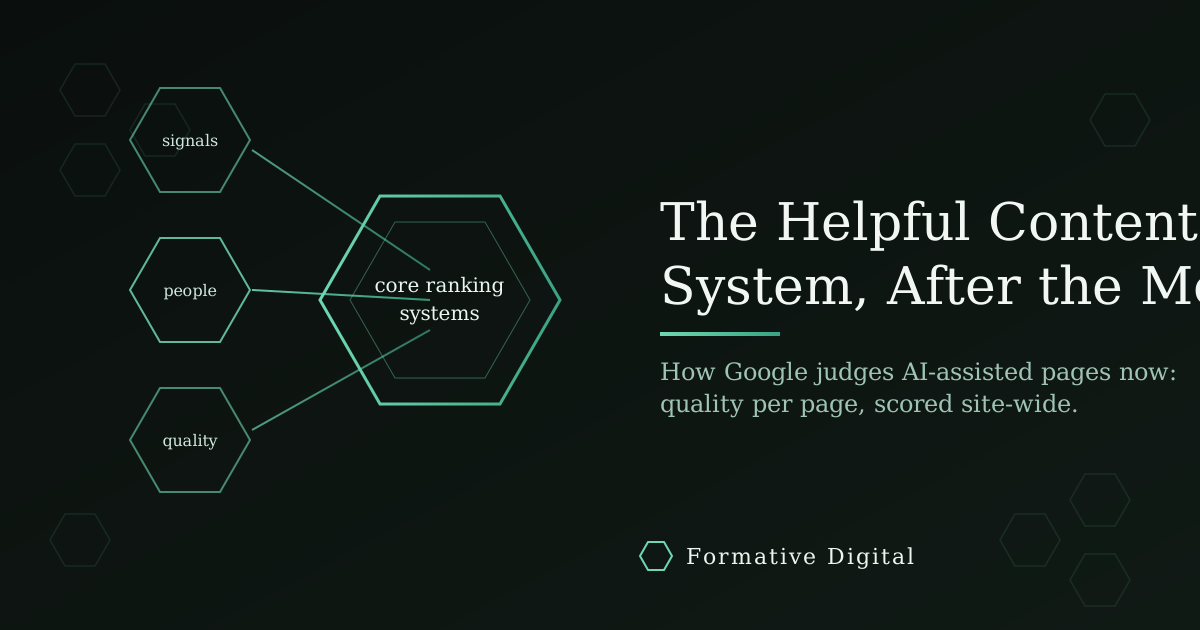
Quick Answer: Google's helpful content system no longer exists as a standalone system. In March 2024 it merged into the core ranking systems, where helpfulness is scored continuously and site-wide. AI-produced content is judged on quality, not production method; scaled low-value publishing triggers suppression, and recovery takes months.
| Date | What changed | What it meant |
|---|---|---|
| August 2022 | Helpful content update launches | A named, site-wide classifier targeting content written for rankings rather than readers |
| February 2023 | Google publishes its AI content guidance | Quality is the test, not whether software or a person produced the page |
| September 2023 | Helpful content update tightens | The most damaging version; many small publishers lost the majority of their traffic |
| March 2024 | System retired, signals merged into core ranking; scaled content abuse spam policy introduced | Helpfulness becomes a continuous signal inside multiple core systems, and volume-without-value becomes an explicit spam violation |
That table is the short version of a story most agency blogs still tell wrong. The phrase "helpful content update" keeps circulating as if a discrete system were still switching on and off, and business owners keep asking whether Google has a rule against AI writing. Neither framing survives contact with Google's own documentation. This page walks through what the system was, what it became, and what that means for anyone publishing with AI assistance in 2026.
What the Helpful Content System Actually Was
Launched in August 2022, the helpful content system was a machine-learning classifier that evaluated whole sites, not individual pages. It asked a blunt question: does the content on this domain exist mainly to attract search traffic, or does it exist to serve the person reading it? Sites judged to be search-first earned a suppressive signal that dragged down every page on the domain, including genuinely good ones.
The September 2023 iteration was the version that made the system famous. It hit hard, it hit small publishers disproportionately, and it produced the recovery stories, or more often the non-recovery stories, that still dominate SEO forums. Traffic losses of 70 to 90 percent were widely reported, and Google representatives confirmed at the time that affected sites should not expect fast rebounds.
The mechanics matter for what comes next: the classifier ran continuously, was weighted site-wide, and carried a memory. Fixing ten bad pages did not release the signal; Google had to re-evaluate the domain as a whole and gain confidence the change was durable.
The March 2024 Merge: Why "HCU Recovery" Is Now the Wrong Frame
In March 2024 Google announced the helpful content system was no longer a standalone system. Its signals were folded into the core ranking systems, meaning multiple systems now evaluate helpfulness rather than one named classifier. Google paired the announcement with a projection that the changes would cut unhelpful content in search results by 40 percent.
This is not a technicality. It changes three practical things:
- There is no single switch to flip back. Before the merge, a site could theoretically shed one classification and rebound. After it, helpfulness assessment is distributed and continuous, so improvement registers gradually as different systems re-score the domain.
- "Was I hit by the HCU?" is unanswerable in 2026. A traffic drop during a core update reflects a blend of quality, relevance, and spam signals. Diagnosing it requires reading your own content honestly against what now ranks, not matching your drop date to an update name.
- Fresh evaluation cuts both ways. Because scoring is continuous, a site that keeps adding thin pages keeps re-earning its suppression. Equally, a site that genuinely improves is re-scored without waiting for a named update, though visible movement still clusters around core updates in practice.
Anyone selling "helpful content update recovery" as a discrete service in 2026 is selling a map of a country that no longer exists. The territory is now just quality, assessed all the time.
The Site-Wide Reality: Your Worst Pages Price Your Best Ones
The most misunderstood property of the helpfulness signals, before and after the merge, is that they weigh the domain, not the page. If a large enough fraction of your site reads as low-effort, the suppression applies to everything, including the well-researched cornerstone piece you spent a week on.
This inverts the usual publishing instinct. Most site owners believe more pages equal more chances to rank, so archives fill with near-duplicate service pages, thin location pages, and auto-summarized posts. Under a site-wide signal, each of those pages is not a lottery ticket. It is a small weight tied to every other page on the domain.
We speak from a position of expensive first-hand experience here. This site once carried 4,237 templated pages generated by keyword-and-city substitution, and the result was a domain that could not rank anything, including its good pages. Removing and replacing that inventory with individually researched pieces is the ongoing project this article is part of. We publish that fact because a page about content quality that hid its own history would fail its own test.
How Google Treats AI-Produced Content: The Actual Policy
Google's published guidance on AI content has been consistent since February 2023 and is shorter than the debate around it: reward high-quality content, "however it is produced." Automation has generated useful content for years, sports scores and weather among them, and Google explicitly declined to make production method a ranking factor.
The same guidance draws the line that matters: using automation, AI included, to generate content primarily to manipulate rankings violates spam policies. The test is intent and output value, not tooling. A subject-matter expert who drafts with a model, then verifies, edits, and adds first-hand knowledge, is publishing legitimate content. A site that publishes four hundred unedited model outputs in a month is spamming, and would be spamming just as much if four hundred underpaid freelancers had typed the same words.
One nuance business owners often miss: Google does not require you to disclose AI assistance, but it does expect accuracy, and models fabricate confidently. In quality terms, the risk of AI-assisted publishing is less "detection" and more "your page confidently states something false, and pages around it do not." Verification is the actual cost of using the tools, and skipping it is where most operations quietly fail the quality bar. Our companion piece on whether AI content ranks in Google covers the ranking-outcome evidence in more depth.
Scaled Content Abuse: Where AI Publishing Does Get Hit
The March 2024 update did not only merge the helpful content signals. It introduced the scaled content abuse spam policy, which targets "many pages" produced primarily for rankings with little value per page. The policy is deliberately method-agnostic. Google closed the loophole where site owners argued their mass content was human-written and therefore safe.
Unlike the gradual helpfulness signals, spam policy violations can draw manual actions: a human reviewer flags the site, a notice lands in Search Console, and pages can be removed from results entirely until the site cleans up and files reconsideration. In the days after the March 2024 rollout, deindexed sites were reported across the SEO press, most of them running exactly the publish-at-volume playbook the policy names.
The practical boundary between legitimate scale and abusive scale is value per page, and it is testable: open five of your pages at random and ask what a reader learns on each that the other four did not teach. If the honest answer is "the city name changed," you are on the wrong side of the policy regardless of who or what wrote the words. We wrote about the ecosystem-level version of this problem in our AI slop warning, and the short version holds: the flood of interchangeable machine text is precisely what makes distinct, verifiable pages more valuable to both rankers and readers.
The People-First Test in Practice
Google's self-assessment questions for helpful content sound abstract until you operationalize them. Here is how we run them against a real page during an audit:
- Existing-audience test. Would this page make sense on your site if Google did not exist? A plumbing company's page on frozen-pipe prevention passes. Its page on "best crypto wallets 2026" does not, and topic drift like that is one of the stronger low-quality patterns Google has named.
- First-hand evidence test. Does the page demonstrate the thing raters call experience? Photos you took, numbers you measured, constraints you hit. A page can be accurate and still show zero evidence its author ever did the work.
- Satisfaction test. Does a reader leave feeling their question was answered, or do they bounce back to the results? Google's rater documentation describes the goal as content "created to help people," and rates main content highly when it shows real effort, originality, and skill.
- Summary test. Is the page mainly a restatement of what already ranks? Summarizing other sources without adding anything is called out directly in Google's guidance, and it is the default failure mode of unedited AI drafting, because a model's training objective is, in effect, a very fluent summary of its inputs.
The rater guidelines, which we unpack fully in our quality rater guidelines explainer, put the same idea in evaluation language: the core question for page quality is "how well the page achieves its purpose," and pages whose purpose is traffic rather than help sit at the bottom of the scale by definition. Raters do not set rankings directly; their aggregated judgments are the benchmark Google tunes its automated systems against, which is why the guidelines read like a prophecy of every quality-flavoured update since.
This Maps to Vector 8: Refresh
Continuous evaluation means a published page is never finished. Formative Digital treats every client page as an asset with a maintenance schedule: re-verify claims, update figures, prune what no longer earns its place. Our guide on how often to update content sets out the working cadence.
What the Machines Can Verify: Structure as a Trust Signal
Helpfulness signals read your prose. Other systems read your markup, and the two reinforce each other: a page whose structured data matches its visible content gives Google a machine-checkable consistency signal, while mismatched markup does the opposite. For an article page, the minimum viable graph looks like this:
<script type="application/ld+json">
{
  "@context": "https://schema.org",
  "@type": "Article",
  "headline": "Your visible H1, matching exactly",
  "author": { "@type": "Person", "name": "A real, named human" },
  "publisher": { "@type": "Organization", "name": "Your business" },
  "datePublished": "2026-07-20",
  "dateModified": "2026-07-20"
}
</script>
Note what this does in a helpfulness context: it commits you, machine-readably, to a named author and honest dates. Sites running scaled anonymous content rarely ship either, because attaching a real person's name to four hundred unedited pages is a reputational decision most people decline to make. The markup is not a ranking trick. It is a public, parseable claim of responsibility, and responsibility is most of what E-E-A-T measures.
Recovery Honesty: What the Timeline Really Looks Like
Here is the part most agency pages soften. If your site carries a helpfulness-flavoured suppression, the realistic sequence is:
- Inventory and triage, weeks one to four. Every indexed URL gets sorted: keep and improve, rewrite from scratch, or remove and noindex. Documented recoveries have typically involved acting on 20 to 50 percent of a site's pages, not trimming a few stragglers.
- Substantive rebuild, months one to four. The surviving pages need what they lacked: named authorship, first-hand evidence, verified claims, current information. Cosmetic edits, date bumps, and paragraph shuffles do not register as change because they do not change what a reader gets.
- Re-evaluation, months two to six after the work is real. Because signals are continuous but weighted over time, Google needs sustained evidence before releasing suppression, and visible recoveries still tend to arrive alongside subsequent core updates. Some sites hit in September 2023 saw only partial recovery more than a year later, which Google representatives acknowledged publicly. Nobody credible can promise your domain a faster path, and results vary with how deep the original problem ran.
The one honest accelerant is subtraction. Removing low-value pages changes your site-wide ratio immediately, which is faster than improving the same pages one at a time. It is also psychologically the hardest step, because those pages represent sunk cost. They are also the anchor.
The Pattern We Keep Seeing in Ontario Audits
A qualitative observation from our audit work, offered as a pattern rather than a statistic: when a small-business site has lost visibility across a core update window, the wound is almost never one bad article. It is a publishing rhythm, a burst of near-identical pages added in a short window, usually a well-meaning attempt to "do content" cheaply, sitting on top of an otherwise legitimate site. The owner remembers the burst as a minor project. The classifier reads it as the site's dominant behaviour, because by page count it often is. The good news inside that pattern: behaviour-shaped problems have behaviour-shaped fixes, and subtraction plus a slower, evidenced publishing cadence addresses the actual signal rather than chasing the update name.
What to Do With This in the Next Quarter
If you publish with AI assistance, or plan to, the merged reality reduces to four working rules:
- Judge every page by value per page, because that is the unit the systems and the spam policy both score.
- Put a named, real person behind the content, in the byline and in the markup, and let them add what only your business knows.
- Audit your existing inventory before adding to it; on a suppressed domain, new pages inherit the old signal.
- Budget recovery in months and measure it across core updates, not weeks and news cycles.
If you would rather have a second set of eyes on that first audit step, the form below gets you a no-charge read on where your domain currently stands, and the findings are yours either way. More of our source-grounded work on ranking systems lives in the research library.
Matt Griffin, Formative Digital: "The merge was Google admitting the obvious: helpfulness is not a feature you bolt onto ranking, it is the whole job. And the AI policy is the same admission from the other direction. Google cannot referee how words get made, only whether they help. We rebuilt this agency's own site on that reading, one researched page at a time, because Truth not tricks is only a slogan until it costs you something. It cost us 4,237 pages."
Frequently Asked Questions
Does the Google helpful content system still exist?
Not as a standalone system. Google retired the separate helpful content system in the March 2024 core update and folded its signals into the core ranking systems. Helpfulness is now evaluated continuously by multiple systems rather than by one named classifier, which is why Google's own ranking systems page no longer lists it separately.
Does Google penalize AI-generated content?
No, not for being AI-generated. Google's published position since February 2023 is that it rewards high-quality content however it is produced. What gets suppressed is low-value content at scale, and the scaled content abuse spam policy applies whether the pages were written by software, by freelancers, or by scraping. The production method is not the test; the value per page is.
How long does recovery from a helpful content classification take?
Months, honestly. Because the signal is site-wide and continuously evaluated, Google needs to re-crawl and re-assess a meaningful share of your domain after you fix it, and visible recoveries have historically clustered around subsequent core updates. Plan for two to six months after substantive cleanup, sometimes longer, and expect partial rather than full recovery in many documented cases.
Should I delete AI-written pages to recover?
Delete or noindex pages that add nothing a searcher could not get from the current top results, whoever wrote them. Keep and improve pages that carry real information: first-hand detail, original data, honest answers. Sorting by production method misses the point; sorting by value per page is what the classifier effectively does, so it is what your cleanup should do.
Can a Canadian small business use AI to write its website content safely?
Yes, if a person who knows the business adds what only the business knows: real service details, real constraints, real local context, verified sources. In our Ontario audit work the failures we see are not AI usage itself but unedited volume, with dozens of interchangeable pages published in bursts. A smaller number of pages carrying genuine operational knowledge holds up.
Sources
- Google (2023, February 8). Google Search's guidance about AI-generated content. Google Search Central Blog. developers.google.com/search/blog/2023/02/google-search-and-ai-content
- Google (2024, March 5). What web creators should know about our March 2024 core update and new spam policies. Google Search Central Blog. developers.google.com/search/blog/2024/03/core-update-spam-policies
- Google (2026). Google Search's guidance on generative AI content. Google Search Central Documentation. developers.google.com/search/docs/fundamentals/using-gen-ai-content
- Google (2023, November). Search Quality Rater Guidelines: An Overview. Google. services.google.com/fh/files/misc/hsw-sqrg.pdf
- Search Engine Land (2024). Google's helpful content update and system: everything we know. Search Engine Land. searchengineland.com/library/platforms/google/google-algorithm-updates/helpful-content-update
Get your free AI visibility audit
See where your business currently stands in ChatGPT, Perplexity, Gemini, and Google AI Overviews. No charge, no obligation, and a reply within one business day.